
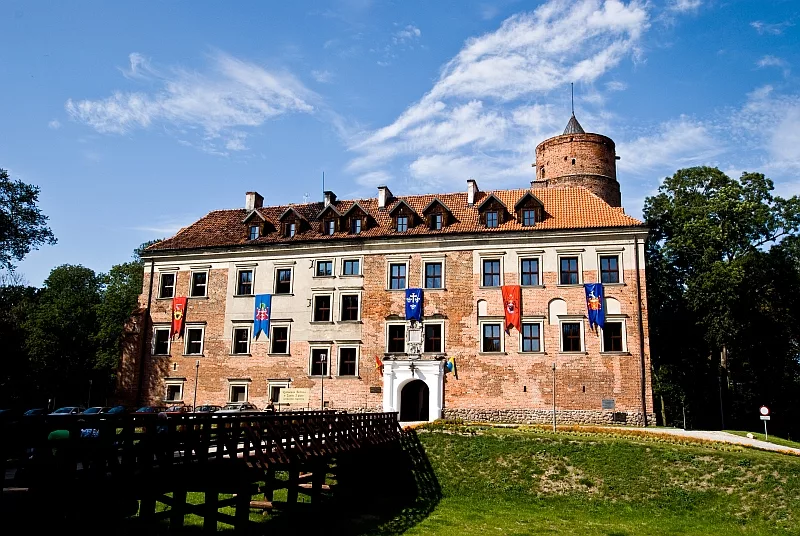
For several centuries Uniejów belonged to the archbishops of Gniezno - the most important dignitaries in old Poland after the king - and it was they who built the fortified castle around which the town grew. Today the castle stands in the shadow of a newer attraction: geothermal waters discovered on the site, thanks to which Uniejów is one of the few towns in central Poland with the status of a health resort.
A castle that survived invasions and partitions
The brick castle was built around 1360 by Archbishop Jarosław Bogoria Skotnicki, on the site of an earlier wooden stronghold destroyed during a Teutonic Knights' raid in 1331. Over the following centuries, the castle served as a residence for the archbishops of Gniezno and a defensive outpost on the border of the diocese, and its walls housed the chapter's treasury and archives during wars. The building has survived to this day in a form close to its original, which is rare in a region where most castles fell into ruin. Since 1995 the castle has operated as a hotel with a restaurant and conference rooms, but its walls, tower and layout still reveal the building's medieval origins.
The legend of the White Lady
A local legend about the White Lady, also known as Uniejka, is connected with the castle. According to the tale, she promised a band of robbers she would lead them to treasure hidden beyond nearby marshes, planning instead to lose them in the wilderness by the Warta river. One of the attackers managed to grab her by the hand before the marsh swallowed them both. Since then, residents of Uniejów are said to have seen a white apparition of a girl in a dress by the river. This is purely a legend, written down and repeated in local folklore - there is no historical evidence for the events that would confirm it, but it is precisely this story that gives the castle an atmosphere other historic residences in the region lack.
Where the thermal baths came from
In the 1990s, exploratory drilling for oil and gas deposits was carried out around Uniejów. No energy resources were found, but hot geothermal water was discovered at a depth of more than two kilometres, reaching a temperature of almost 70 degrees Celsius at the source. The first thermal complex by the castle opened in 2008, and in 2012 the town gained the status of a health resort - one of the few in Poland based not on traditional mineral springs but on geothermal waters. The water contains compounds of sulphur, iodine and iron among others, and its composition is one of the arguments behind Uniejów's present-day health offer.
What else to see in town
Besides the castle and the thermal baths, it is worth walking around the small Old Market Square in Uniejów and seeing the wooden "Koźlak" windmill, one of the few surviving monuments of old wind-milling in the region. Close to the castle also stands a manor house, and by the thermal complex there is a graduation tower with a pump room, where you can experience a microclimate similar to the seaside without travelling to the coast.
How to plan a visit
Uniejów lies in the western part of the Łódź region, less than an hour's drive from Łódź. Touring the castle and the market square itself is a one- to two-hour walk, but most visitors stay longer because of the thermal baths - it is worth planning at least half a day, or ideally a full day with a soak. Tickets to the baths and for touring the castle are paid, and prices and opening hours change seasonally, so it is worth checking them directly before travelling. More ideas for trips around the region can be found in the "Poznaj Łódź" (Discover Łódź) series, linked from here.
Be the first! Add a comment.
You need to log in to add a comment.
Log in