
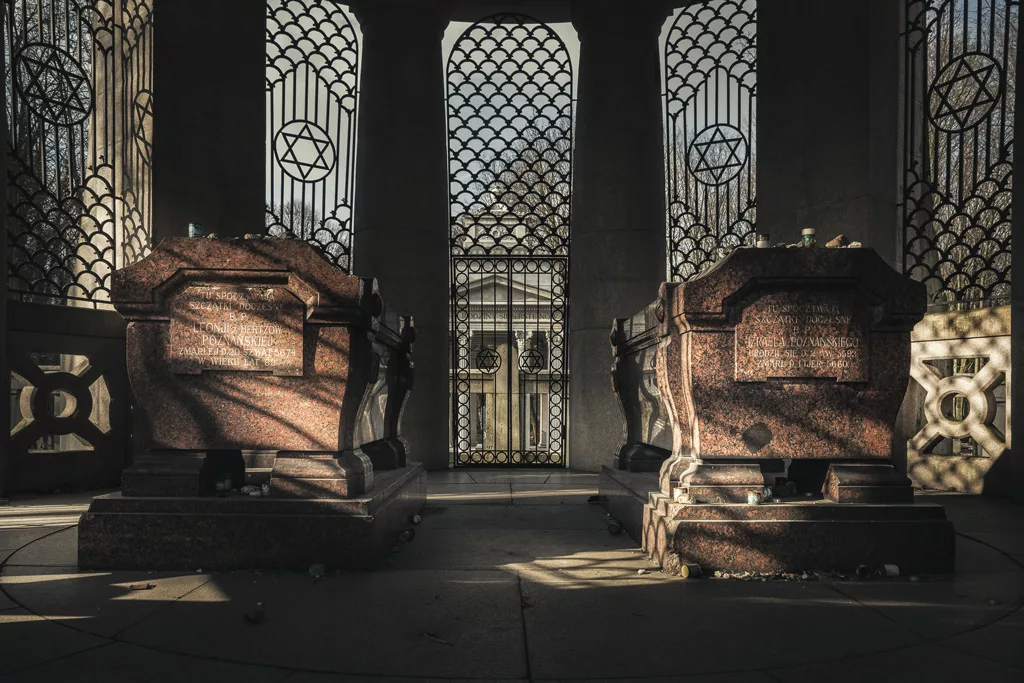
The New Jewish Cemetery in Łódź was established in 1892, when the old cemetery on today's Wesoła Street could no longer accommodate the city's growing Jewish community. Today it covers 42 hectares between Bracka and Zmienna streets and is considered the largest surviving Jewish cemetery in Europe. Between 180,000 and 230,000 people are buried here, and around 160,000 gravestones survive across 131 sections.
The cemetery's size reflects the pace at which pre-war Łódź grew. A textile city and one of the fastest-growing cities in the Łódź region, it attracted Jewish workers, merchants and factory owners faster than almost any other city in the region, and its Jewish community numbered over 200,000 people before the war.
The Poznański Mausoleum - the most imposing tomb in Europe
The cemetery's main attraction is the mausoleum of the Poznański family, built for Izrael Poznański, owner of Łódź's largest textile factory, and his wife Leonia. The Art Nouveau structure with a mosaic-covered dome is sometimes described as one of the largest Jewish tombs in the world. It stands near the main avenue and is the first stop for nearly all visitors.
In another part of the cemetery stands the tomb of the Silberstein family, guarded by four stone lions - one of the more recognisable gravestones on the site, though far more modest than the Poznański Mausoleum.
The Ghetto Field - the youngest and most painful part of the cemetery
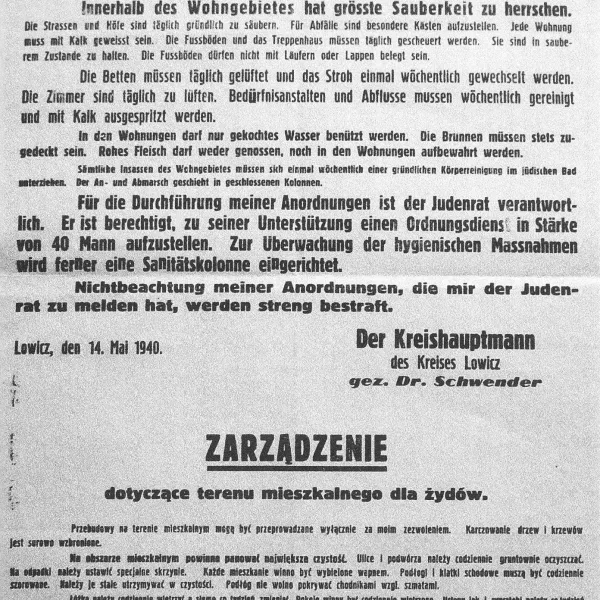
In the northern part of the necropolis lies the so-called Ghetto Field, the burial place of around 45,000 people who died in the Łódź ghetto (Litzmannstadt Ghetto) between 1940 and 1944, mostly from hunger, exhaustion and disease. The graves here are modest, tightly packed, many without names. It is the youngest part of the cemetery and, at the same time, a testimony to what everyday life in the ghetto was like: death on a scale so vast that there was neither time nor material to commemorate each person individually.
It is worth walking through this part of the cemetery in silence, without hurry - this is not a place for smiling photographs.
Who rests here
Besides the Poznańskis, the cemetery holds representatives of almost all the major Łódź factory-owning and merchant families of Jewish origin, as well as rabbis, doctors, lawyers and community activists. For many foreign visitors, especially from Israel and the United States, the cemetery is the destination of a sentimental journey - a search for the graves of ancestors who emigrated from Łódź before the war or died in the ghetto.
How to get there and when to visit
The entrance to the cemetery is from Zmienna Street, although the site's official address is Bracka 40. From April to November the necropolis is open Sunday to Friday (except on Jewish holidays) from 9:00 to 17:00, and until 15:00 on Fridays. From November to the end of March the hours are shorter: 9:00 to 15:00. The cemetery is closed on Saturdays.
The entrance ticket costs around 20 zlotys, but no fee is charged from visitors coming to their relatives' graves, and admission is free on the first Sunday of every month - it is worth checking these rules before a visit, as they can change. Men should cover their heads on the cemetery grounds; kippahs are usually available at the entrance for visitors without their own head covering.
How much time to plan
For an unhurried walk around the main points - the Poznański Mausoleum, the Silberstein tomb, the Ghetto Field - it is worth setting aside at least one and a half to two hours. Visitors interested in genealogy and looking for specific graves should expect a longer stay; the cemetery's dedicated website, where a section's location can be checked in advance, is often helpful.
The cemetery lies close to other places connected with the history of Łódź's Jews. Not far from here is the Park of Survivors, and a little further, on the other side of the former ghetto, is Radegast Station, from where transports left for the death camps. In the city centre it is also worth seeing the Reicher Synagogue, the only pre-war synagogue to survive the war.
Together, all these places give a fuller picture of what Jewish Łódź once was, from the industrial rise of the city, through the tragedy of the occupation, to the modest but still living memory of today. More places of this kind can be found on the list of cemeteries and monuments in Łódź and among the historic sites of Łódź, and the wider historical context of the city is gathered in the Poznaj Łódź (Discover Łódź) section.
Be the first! Add a comment.
You need to log in to add a comment.
Log in