The Jewish Cemetery at Bracka Street is a place rich in Łódź's history. Among the old gravestones and monuments, one can learn about the history of the city's Jewish community, which before the Second World War was one of the largest in Poland.
The new Jewish cemetery in Łódź, at Bracka Street 40 with an entrance from Zmienną Street, is the largest Jewish necropolis in Poland and one of the largest in Europe. It covers more than 40 hectares, with approximately 160,000 gravestones preserved, and in its southern part lie victims of the Łódź ghetto.
The cemetery was opened on 10 November 1892 on land transferred to the Jewish community by industrialist Izrael Poznański. It lies in southern Bałuty, in a block between Bracka, Zagajnikowa, Zmienną and Inflancka streets, and covers approximately 42 hectares divided into 131 sections. Between 180,000 and 230,000 people were buried here. The necropolis is entered in the heritage register under number A/276 from 17 September 1980, and in 2015 it was declared a Monument of History by presidential decree. It is maintained by the Jewish Religious Community in Łódź.
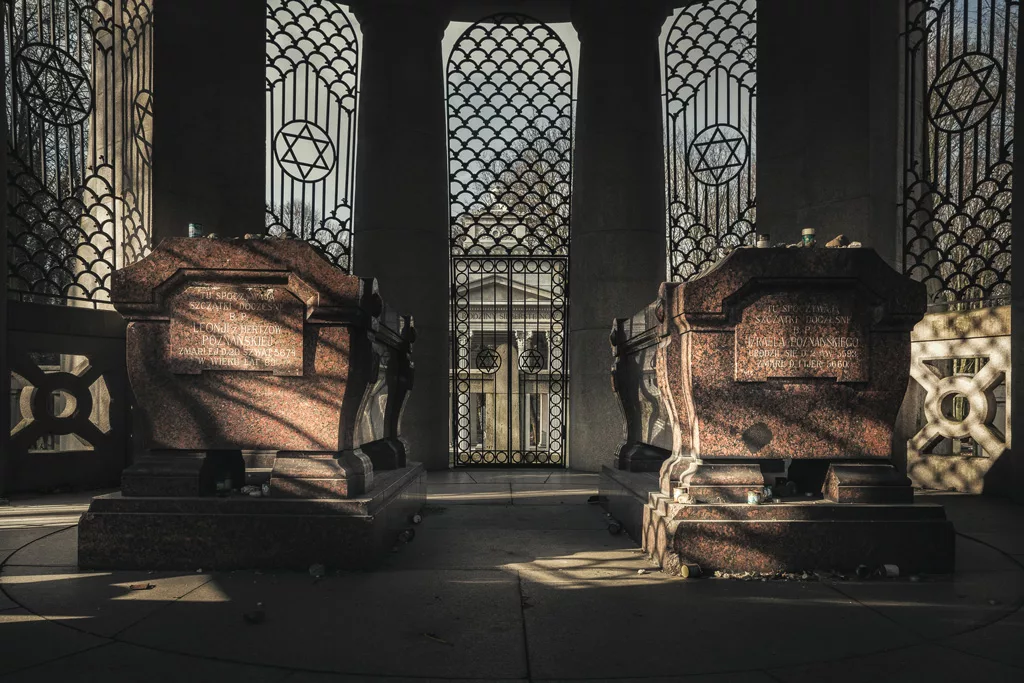
The two most recognisable structures in the cemetery were designed by the same architect, Adolf Zeligson. The mausoleum of Izrael Poznański is considered the largest Jewish tomb in the world, and inside its dome a restored historical mosaic has been preserved. The pre-burial house with an area of 850 square metres was opened in April 1898; its construction was financed by Mina Konstadt with a sum of 18,000 roubles.
Among those buried are the parents of Julian Tuwim and the parents of Arthur Rubinstein, as well as industrialists, doctors and activists of the pre-war community. Gravestones from the nineteenth and twentieth centuries show the full scale of the former community: from modest headstones to monumental factory owners' tombs.
The Ghetto Field is the collective section of the cemetery at Bracka Street, where over 40,000 prisoners of the Łódź ghetto were buried between 1940 and 1944. Sources give figures of approximately 43,000 to 45,000 dead. The graves are mostly unmarked, marked with low, uniform plaques. In the pre-cemetery section stands a monument dedicated to the victims of the ghetto and extermination camps, and a separate plaque commemorates 5,000 Czech Jews interned in the Łódź ghetto, most of whom died in Chełmno nad Nerem.
This is an active cemetery and a place of remembrance, so religious rules apply here, not tourist customs. Men enter only with head covering; a regular cap is sufficient. The cemetery is closed on the Sabbath and Jewish holidays. People looking for graves of relatives can use the database of buried persons maintained by the Monumentum Iudaicum Lodzense Foundation based at Pomorska Street 18. The Foundation also collects memories of the buried. Part of the Ghetto Field is cared for by volunteers gathered around the Guardians of Memory.
| Monday | 09:00 – 15:00 |
| Tuesday ← today | 09:00 – 15:00 |
| Wednesday | 09:00 – 15:00 |
| Thursday | 09:00 – 15:00 |
| Friday | 09:00 – 13:00 |
| Saturday | Closed |
| Sunday | 09:00 – 15:00 |
Hours per Google Places - may change on public holidays.

Be the first! Add a comment.
You need to log in to add a comment.
Log in