
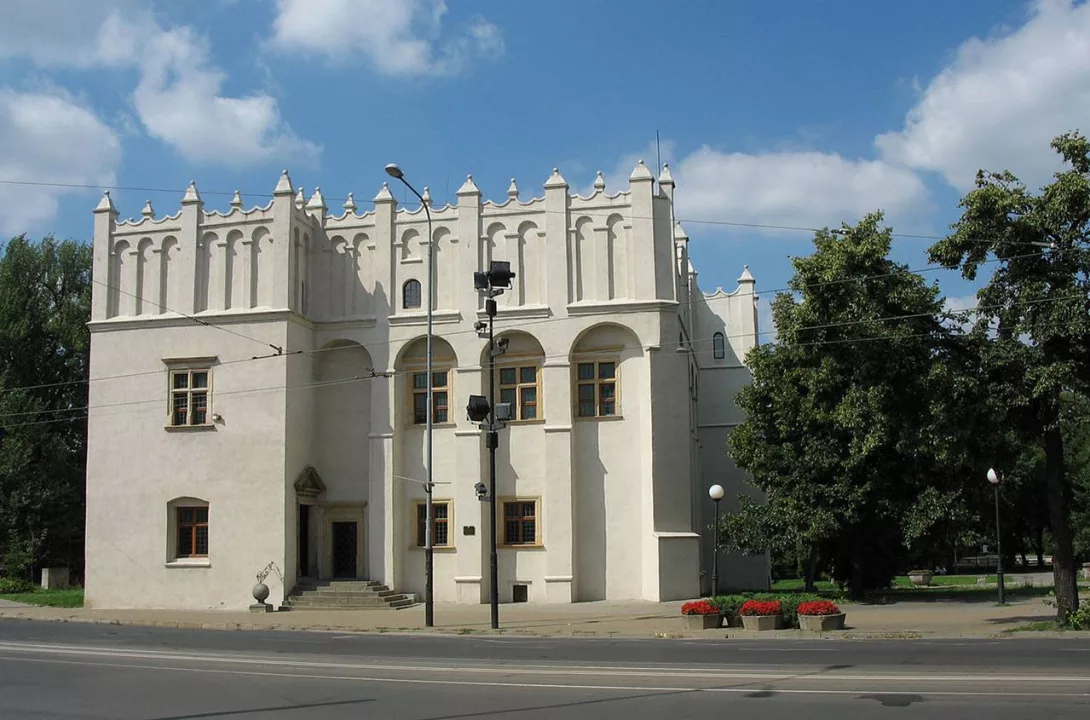
Pabianice lie a dozen or so minutes from Łódź, and for most visitors the visit ends at the Old Market Square and the Krusche-Ender factory. Few people look here for traces of the town's Jewish history, yet there is plenty to find - though you need to know where to look, since most of the former buildings no longer exist.
A town of weavers where one in five residents was Jewish
Jewish settlement in Pabianice began at the start of the 19th century, alongside the town's development as a textile centre. By 1897 the Jewish population had exceeded 5,000 people, about 19 percent of all residents of Pabianice. The Jewish community became an important part of the local economy, closely tied to the weaving industry that remains the town's calling card to this day.
Over time Pabianice also became a significant centre of religious life - several Hasidic groups and rabbinical courts were active here, and prayers were held first in private homes, then in a rented building on today's Bożnicza street. The name of this street - Bożnicza, meaning "synagogue street" - has survived to this day and is one of the few linguistic traces of that history left in the town.
The synagogue that is no longer there
In 1880 a brick synagogue was built on the same street. It was a solid building with rich interior polychromy by Majer Rosenzstein - one of the more important Jewish houses of worship in the Łódź region outside Łódź itself. It did not survive the war and occupation: the building was destroyed, and it was never rebuilt afterwards. Today nothing stands on the site to recall its former function - the only lasting trace is the street name.
The cemetery that still exists
The Jewish cemetery has survived in far better condition. It was established between 1838 and 1847 in the south-western part of town, on today's Jana Pawła II street. The site is enclosed by a wall of concrete slabs with remnants of barbed wire, and the necropolis is owned by the Jewish Religious Community in Łódź. The cemetery today covers just 0.85 hectares - a small area compared to its original size, since part of the land was taken over during and after the war.
Why it is worth remembering while walking through Pabianice
The history of Jewish Pabianice shows a pattern repeated in dozens of towns across the Łódź region: a vibrant, multi-generational community, closely woven into the town's economy, disappeared within a few years of war and occupation, leaving behind mainly street names, single buildings and cemeteries. In Pabianice this process is especially visible, because the town is small and has preserved its pre-war urban layout well around the Old Market Square.
In practice: how to see these traces
The cemetery on Jana Pawła II street is private property belonging to the Jewish community - it is still a burial site, not a tourist attraction, so when visiting behave as you would at any cemetery: quietly, with no eating or drinking on the grounds, and men traditionally cover their heads. The gate sometimes needs to be arranged in advance - it is worth checking before you go, as the site is not always open to casual visitors.
More on the history and remnants of Bożnicza street, and wider context, can be found at the Museum of the Town of Pabianice, housed in the Kraków Chapter's Manor in the town centre. From Łódź you can reach Pabianice by suburban tram in about 40 minutes, which makes this route easy to combine with the rest of Łódź within a single day. A wider context of the region's multicultural history can also be found in the Łódź of Many Cultures series and in the Discover Łódź section.
Be the first! Add a comment.
You need to log in to add a comment.
Log in