
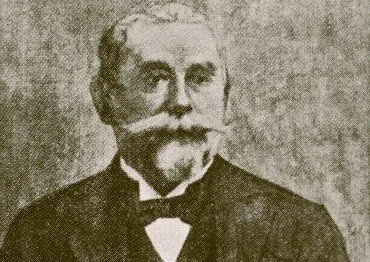
When people talk about the Jewish factory owners of Łódź, almost always the first name mentioned is Izrael Poznański - builder of an industrial empire whose palace today houses the Museum of the City of Łódź. Poznański, however, was not alone. Alongside him, dozens of Jewish industrial families were active, without whom it is hard to imagine the Łódź textile industry at the turn of the 19th and 20th centuries.
Markus Silberstein and his trading house
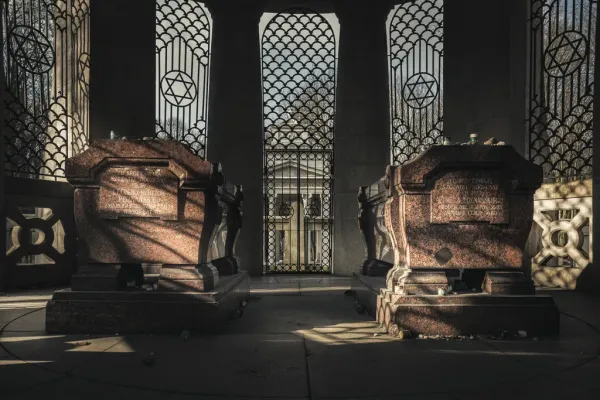
One of the more important, though today less well-known, names is Markus Silberstein, owner of the M. Silberstein Trading House and co-founder of the "Dąbrówka" worsted spinning mill - one of the larger plants of its kind in the city. The Silberstein family left a literal mark on the Łódź landscape: their family tomb at the Jewish cemetery on Bracka street, guarded by four stone lions, is one of the most recognizable and most frequently photographed gravestones in the entire necropolis - one of the largest Jewish necropolises in Europe.
Jarociński, Rozenblatt, Budzyner - a network of connected families
Among the Jewish industrialists of old Łódź, names such as Zygmunt Jarociński, Szaja Rozenblatt and Salo Budzyner are also mentioned - names that today rarely appear outside specialist historical studies, even though in their time their owners helped build the Łódź industry on equal footing with better-known families. As with Poznański or Scheibler, their fortunes were built on textiles - spinning mills, weaving mills, finishing plants - the same branch of industry that made Łódź one of the largest textile centres in Europe at the time.
The Ejtingon brothers and international connections
Among the lesser-known but significant figures were also the Ejtingon brothers, whose trading and industrial activity extended beyond Łódź itself, placing the city within broader, international networks of trade in raw materials and textiles. Connections of this kind show that prewar Jewish Łódź was not a closed, local community, but a node in a much wider European economic network.
Why these names are less known today
Unlike Poznański, whose palace became one of the city's most important landmarks, or Scheibler, whose residence and tomb chapel are among the most visited sites at the Old Cemetery, many smaller Jewish factory owners did not leave behind equally monumental buildings - their company headquarters or tenement houses either did not survive the war or were rebuilt without preserving the original owner's name. This means their history lives on today mainly in archives and on gravestones, such as the Silberstein tomb.
Where to look for their traces
The best place to encounter the history of the lesser-known Jewish factory owners of Łódź remains a walk through the Jewish cemetery on today's Zagajnikowa street, where, alongside the monumental mausoleum of the Poznański family, stand dozens of less imposing but still impressive tombs of other industrial families, including the Silbersteins. It is also worth visiting the Museum of the City of Łódź in the former Poznański palace, where the exhibition on the city's industrial history also mentions other factory-owning families, and browsing the collections of the Virtual Shtetl, which holds an extensive list of Jewish merchants and industrialists connected to Łódź. Their graves are worth comparing with the imposing family mausoleum at the Scheibler Palace, to get a sense of the scale of the fortunes built in the city at the time by factory owners of various faiths.
More about the city's Jewish history can be found in the "Poznaj Łódź" (Discover Łódź) series, linked from here, and a review of other landmarks of old industrial Łódź is in the historic monuments category.
Be the first! Add a comment.
You need to log in to add a comment.
Log in