
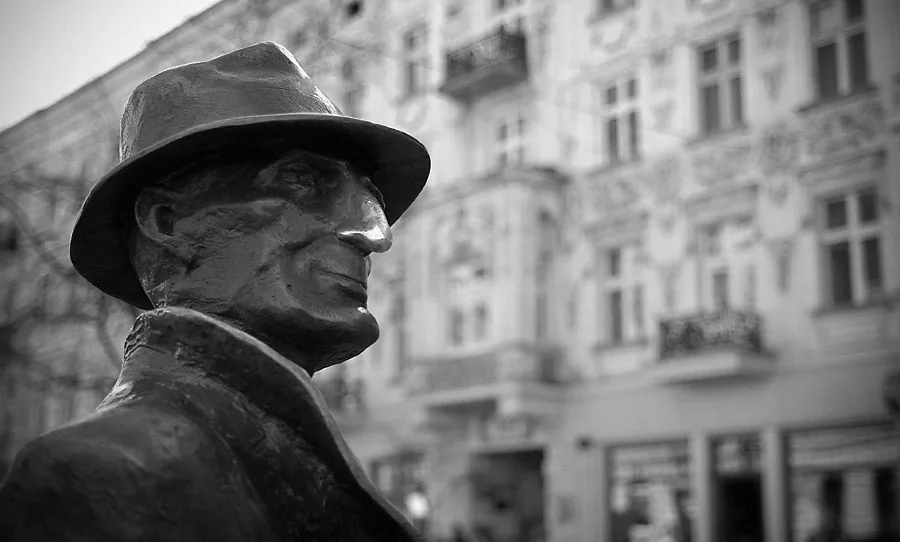
Artur Rubinstein (1887-1982)
Artur Rubinstein was undoubtedly a piano virtuoso and one of the most outstanding pianists of the twentieth century. Beyond that, he was also a great master of everyday life – a calm, good, and positively oriented person. Despite living through very difficult times (partitions, two wars, the Holocaust, communism), he knew how to celebrate life and draw from it abundantly. He was characterized by elegance, was a great patriot, which he demonstrated many times over. He was a Pole of Jewish origin, which he always remembered and strongly emphasized. His love for Polishness is evident in numerous situations, including this one, which is exceptional. During a recital performance at a ceremony marking the signing of the Declaration of the United Nations in San Francisco, he notices the absence of the Polish delegation and flag. He becomes furious, delivers a sharp, unplanned speech, and plays Mazurka Dąbrowskiego. These facts speak for themselves.
He was born into the Jewish family of a Łódź businessman and spent his young years here, that is, the first decade of his life. They occupied an apartment at ul. Południowa 28 (currently Rewolucji 1905 r.). It is worth making a small digression here: next to the Rubinstein family home was a confectionery of Aleksander Roszkowski, which young Arturek willingly frequented (this fact would later echo in his memoirs). It was in Łódź, of all places, that he learned to play the piano (lessons were taught by Adolf Prechner) and gave his first public performances. He continued his studies in Warsaw with Aleksander Różycki, and later at the Imperial-Royal Academy of Music in Berlin and Paris. There he studied piano, and Henryk Barth and Józef Joachim gave him valuable guidance. The year 1904 can be considered a turning point when he launched his world career with a piano concert.
In 1932, he chose Aniela as his wife, daughter of Polish conductor Emil Młynarski, with whom he had four children – Ela, Paweł, Alina, and John. They settled in the United States. In Cuba, he had a tobacco plantation, through which he was able to produce cigars.
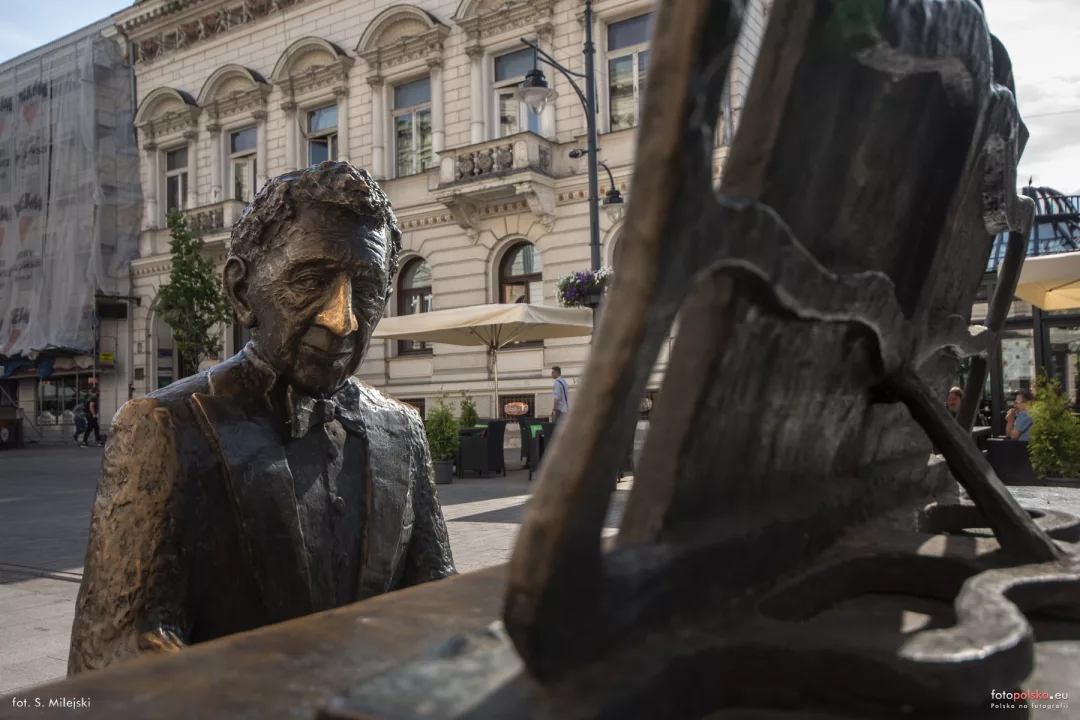
His fame grew year after year as he performed in many places throughout the world. He disseminated, among others, the music of Frédéric Chopin and Karol Szymanowski. He won many awards and was valued by many distinguished artists and ordinary people. In this commitment to his professional and family life, he did not forget his hometown. Evidence of his love for his native region is the concert in 1975, with which he graced the 60th anniversary celebrations of the Filharmonia Łódzka (Łódź Philharmonic).
In recognition of his merits, the Filharmonia Łódzka and a passage (connecting al. Kościuszki and ul. Piotrkowska) located opposite Rubinstein's family home were named after him. Cyclic competitions bearing his name also take place in Łódź.
In the documentary film "L'amour de la Vie," Rubinstein said: "When I was a little boy, I did not want to speak, but to sing." For this documentary, the pianist received an Oscar.
From Artur Rubinstein's memoirs:
"But Noemi and I looked at all these shortcomings with completely different eyes: we loved Łódź! It seemed to us that the factories were castles with magnificent towers, the Tsar's sentries were monsters, and passersby on the streets were disguised princes and princesses." p. 15 ("My Young Years")
"The most important event of those times for me, however, was the arrival in Łódź of a small symphony orchestra conducted by the Dutchman Julius Kwast. The orchestra then performed Grieg's Peer Gynt Suite I, which moved me so much that upon returning home – to the family's amazement – I played nearly the entire piece from memory. Mr. Kwast, invited to our home, listened to my playing and declared that it was time for me to begin taking piano lessons." p. 16 ("My Young Years")
Julian Tuwim (1894-1953)
Author of "Lokomotywa" (The Locomotive) and other verse works for children, juggling humor and apt, poetic language. Almost everyone has heard of Julian Tuwim, but not everyone knows that he was born in Łódź on ul. Widzewska 44 (currently Kilińskiego 46) in an assimilated Jewish family. The place of his education was the State Male Gymnasium in Łódź. Various parts of the city and its nooks and crannies were therefore not unfamiliar to him, and he gladly recalled them in his works, dressing them in the language characteristic of his artistic expression. His mother kindled his love of literature, a woman who loved the Polish language and poetry, and young Julek cultivated and developed this passion. As a result of this inclination came his first poetic attempts – at age seventeen, he translated a verse by L. Staff into Esperanto, and his poem "Prośba" (Request) appeared in the pages of "Kurier Warszawski."
He decided to study law and Polish literature, which he did not complete. During those years, Tuwim was actively involved in the cultural and artistic life of the city. He was a co-founder of the poetic group Skamander and collaborated with the journal "pro Arte et Studio." That same year, in 1919, he married Stefania Marchew. He subsequently became a member and founder of the Union of Scenic Artists and Composers (Zaiks).
The outbreak of World War II marked the beginning of Tuwim's emigration. He stayed longer, for five years, in New York. Here too he continued to develop literarily, writing for various newspapers such as "Robotnik" and "Nowa Polska," and participated in the city's artistic life. He returned to Poland in 1946. He was treated with great respect and served as artistic director at the Teatr Wielki (Grand Theatre). Together with his wife, he adopted a daughter, Ewa. For much of his life, he suffered from neurotic disorders. He died of a heart attack in Zakopane on December 27, 1953.
Tuwim was not only a poet but also a creator of vaudevilles, sketches, and song lyrics. He was an author of verses for children. He translated Russian literature. He wrote extensively for literary journals, of which he was also an editor – "Skamander," "Cyrulika Warszawskiego," and "Wiadomości Literackie." His poetry was bipolar – he wrote in beautiful poetic language but also used vulgarisms. Tuwim's texts are filled with wordplay and specific humor.
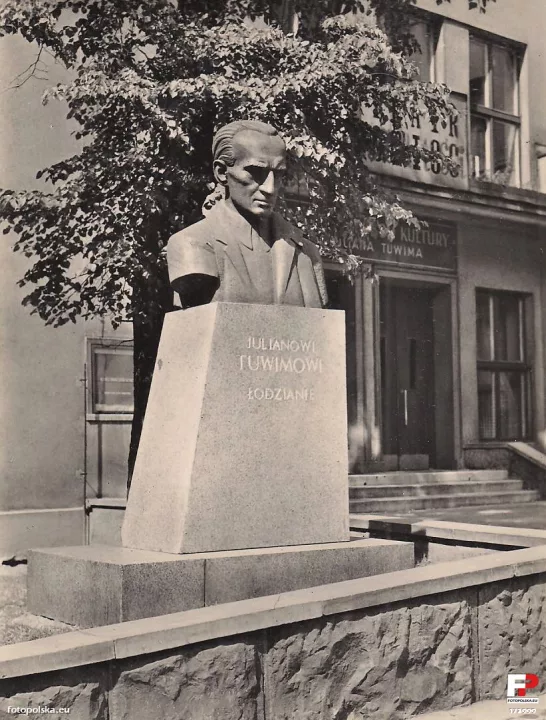
Tuwim's connections to Łódź
First and foremost, they are places of residence. The aforementioned ul. Widzewska 44, later 1 Maja 5, Struga 42, Narutowicza 54, and Traugutta 12. However, the author of "Kwiat Polskie" (Polish Flowers) is connected to Łódź by more places than just family homes. Tuwim performed on the stage of the Bi Ba Bo cabaret in the Savoy Hotel (a place associated with the Łódź bohemian lifestyle). After World War II, the PICK Literary Club operated there. At Piotrkowska 72, there was also the Teatr Syrena (Siren Theater) and a cabaret stage, which Tuwim visited. Meanwhile, from the balcony at Piotrkowska 88, he observed the revolutionary events of 1905, which later found their echo in "Polish Flowers." At number 96, there was the editorial office of "Szpilki" (Pins), where Tuwim published his texts.
The first library lending service located on ul. Struga 5 was a very important place for Łódź residents. Tuwim often spent time there and also advocated with the Department of Culture and Art to keep it from closing in 1950. Unfortunately, this establishment stopped functioning five years later.
Łódź in literature
Tuwim also marked his connection to the city with numerous texts about it. In one of his works, he recalls the mascot of the oldest Polish veterinary clinic founded in 1890. This symbol is a horse located at the top of the veterinary clinic building at ul. Kopernika 22, officially named "Veterinary Clinic for domestic animals and a model English forge."
Tuwim was a frequent visitor to the place of his gymnasium education at ul. Sienkiewicza 46 – he supported talented young people financially, caring for their living conditions and helping them find work.
He often went to a confectionery located at Piotrkowska 53 for treats; it was here that he spent his first earned money.
He also described Helenów park, established by the Anstadts in 1881, which had many attractions – a theater, a menagerie, a restaurant, a cycling track, and many, many others. For the author, it was an "enchanted garden." He also used this synonym for the courtyard at a building on ul. Struga, where he once lived. He also liked to spend time in the square behind his father's bank on ul. Moniuszki, in the hotel garden, where there was a cabaret stage.
Of course, the above examples are just a drop in the ocean. Tuwim wrote about Łódź a lot, which allows us to know him not only as a writer but also as a resident of the "promised land." Exploring these literary paths is truly fascinating.
Izrael Kalmanowicz Poznański (1833-1900)
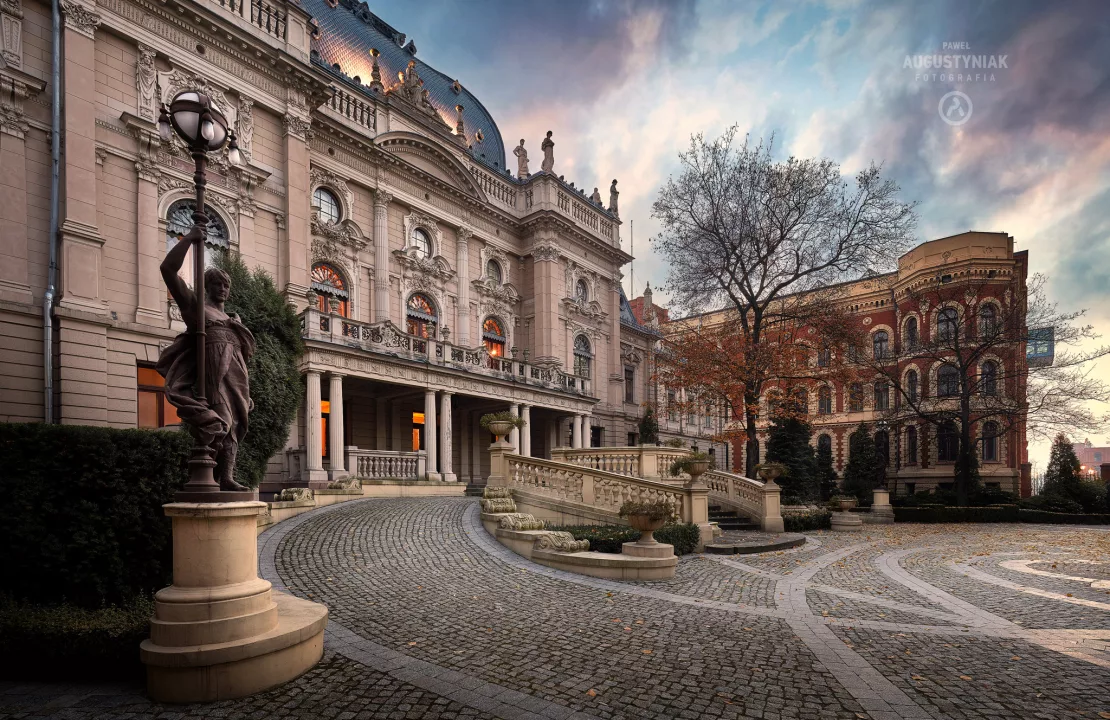
It is remarkable that so little has been preserved for posterity about such a recognized manufacturer for the city – two photographs and a portrait. Few stories about him have been preserved either, and if they have, they seem more like fairy tales than historical truth. However, we know something, and it is truly worth remembering this figure, because his life significantly influenced the development of industrial Łódź. In his former palace today stands the Museum of the History of the City of Łódź, which along with Poznański's factory is numbered among the most valuable industrial monuments of Europe. So who was this man who rendered such great service to Łódź?
Izrael Poznański was born in 1833 in Aleksandrów Łódzki, but spent his childhood in Łódź. He lived with his family in the Old Town on ul. Podrzeczna 24 and attended the Russian-German County School in Rynek Nowego Miasta (present-day Plac Wolności). His father, Kalman Poznański, ran a shop selling yard goods and spices, which probably inspired his son's passion for trade. Thanks to his sister Dwojra (Dorothy), Izrael was able to complete not only cheder but also elementary school. He then gained experience in commercial practice and married Leonia Hertz, a wealthy Warsaw resident, with whom he had seven children. Together they became managers of a fairly large estate, consisting of property handed down to Izrael by his father and his wife's estate. Izrael established the I.K. Poznański Trading House, which he located at the corner of the Old Town and ul. Drewnowska. He traded goods and produced textiles in a small manufactory (in 1859, production amounted to 100,000 meters of cotton, wool, and linen fabrics). Izrael's wealth multiplied significantly. The manufacturer owned properties in the Old Market and on ul. Drewnowska 2. He sold thread from the plants of Karol Scheibler. He also acquired land in the Łódka river valley, through which his influence expanded even further. The area from ul. Stodolnianej (currently Zachodniej) to the cemetery on ul. Srebrzyńskiej – this was the location of Poznański's factory settlement. He established a cotton mill, a spinning mill, a bleach mill, an aperture mill, a dye works, and a fabric printing facility. The entire factory complex covered approximately 30 hectares. Revenues continued to rise until one day in 1880, they reached a substantial amount of 7 million rubles. A workers' settlement arose at the factory for several thousand people, over whom Poznański extended his heartfelt care. Poznański's enterprise acquired a new name: Joint-Stock Company for Cotton Products I.K. Poznański.
Philanthropic activities
Poznański cared about the needs of everyone who turned to him for help. His response to requests included, among others, financing the transfer of a church from ul. Zgierska to the grounds of the former cemetery on ul. Ogrodowa, funding a hospital for Jews, and donating land for a cemetery on ul. Bracka. Besides this, Izrael provided financial help to the Łódź Jewish Charitable Society and financed municipal projects. He did not spare money for the construction of St. Alexander's Church or the Warsaw Polytechnic. He also did not abandon artists in need.
Poznański's places in Łódź
Łódź owes a great deal to him. His scattered estates throughout the city delight the eye to this day – for example, the house he built for his son Maurycy on ul. Cegielnianej and for his daughter Anna on ul. Spacerowa (al. Kościuszki 4). His palace was also located on ul. Gęsia and Długa (Gdańska 32). Izrael's fortune was powerful. In 1900, it amounted to 7.2 million rubles. After his death, his son Ignacy managed the firm; production systematically increased until World War I disrupted production plans.
What remains? Architecturally exceptional buildings – Poznański's Palace and today's Manufaktura, as well as numerous workers' houses. The centerpiece of this place is a five-story cotton spinning mill made of red unplastered brick, having features of ancient defensive architecture (currently Hotel Andels and a conference center are located here). The remaining buildings in the settlement area are equally interesting – inspired by medieval castles.
Be the first! Add a comment.
You need to log in to add a comment.
Log in