
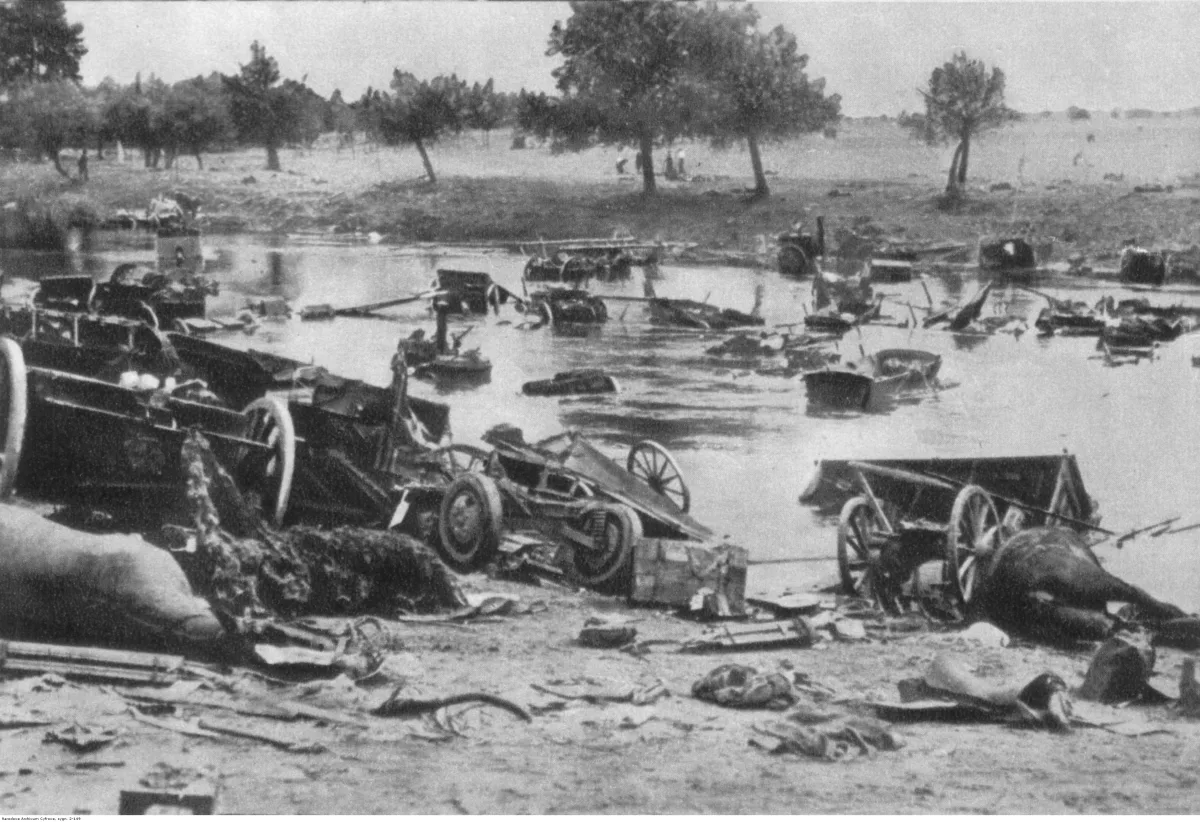
After the German invasion of Poland on 1 September 1939, the "Poznań" army under Gen. Tadeusz Kutrzeba and the "Pomorze" army under Gen. Władysław Bortnowski were withdrawing deeper into the country, avoiding encirclement. Instead of continuing the retreat, the command decided to strike the flank of the German forces advancing on Warsaw. This was the start of the battle fought in the basin of the Bzura river, in what is now the Łódź region.
How did the fighting unfold?
The Polish attack was launched from the Bzura between Łęczyca and Piątek, striking towards Stryków. Over the following days, Polish units tried to push through Łowicz towards Skierniewice. The most dramatic clashes came on the night of 17-18 September, when Polish forces made a final attempt to break through between Sochaczew and the Vistula, trying to reach a Warsaw that was still defending itself.
How many troops took part in the battle?
More than 250,000 soldiers fought on the Polish side, and a similar number on the German side - in total, more than half a million people took part in the battle, making it the largest battle of the 1939 September campaign. The German forces, mainly the 8th Army, were commanded by Gen. Johannes Blaskowitz.
What were the losses?
The Polish side suffered heavy losses: nearly 16,500 killed, 32,000 wounded, and over 100,000 soldiers taken prisoner. German losses are estimated at around 8,000 killed and wounded. The battle ended in defeat for the Polish forces, but it delayed the German advance on Warsaw and gave the capital extra time to prepare its defence.
Why does this battle matter?
The strike from the Bzura was the first offensive operation aimed at the Wehrmacht since the start of the war - and it remained the only one of its kind until 1941. Despite the defeat, the sheer determination of the "Poznań" and "Pomorze" armies to counterattack, rather than retreat passively, earned respect even among their opponents. For the Łódź region, the Battle of the Bzura meant weeks of fighting on home ground - towns such as Łęczyca, Łowicz and Stryków changed hands repeatedly.
What can be seen on the battlefield today?
In Łęczyca stands the monument to the Heroes of the Battle of the Bzura, commemorating the soldiers who died in this fighting. It is worth combining a visit with the Zamek Królewski (Royal Castle), today a museum that also tells the story of the town's wartime history.
Kutno was previously home to a separate Muzeum Bitwy nad Bzurą (Battle of the Bzura Museum), a branch of the local regional museum - this institution is currently closed, so it is worth checking before planning a trip. The region's history from the Second World War period can instead be explored at the Muzeum Pałac Saski w Kutnie (Saxon Palace Museum in Kutno).
How to plan a visit to the battle sites?
The route through the Bzura battlefields covers several towns between ten and several dozen kilometres apart - Łęczyca, Łowicz, Stryków and Kutno - so it is most convenient to visit by car, in the course of a single day. Monuments and memorial sites are freely accessible all year round, while museums have their own opening hours and, in some cases, an admission fee, which is worth checking before setting out.
More about the events of September 1939 in the Łódź region can be read in other articles in the Poznaj Łódź (Discover Łódź) section, and a full list of the region's monuments and museums can be found in the attractions catalogue.
Be the first! Add a comment.
You need to log in to add a comment.
Log in