
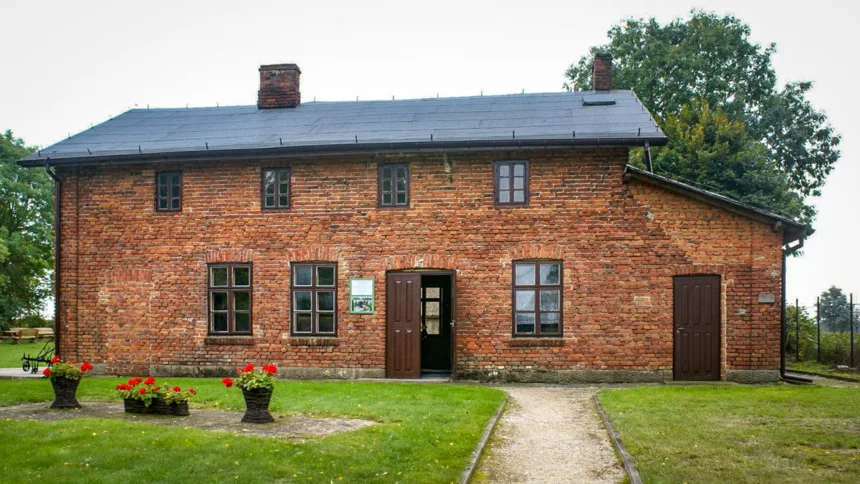
Today, people travel to Lipce Reymontowskie, a small village in Skierniewice county, mainly to see the place that inspired one of the most important Polish novels of the 20th century. The very idea that the village should carry the writer's surname in its name came from a very specific, documented episode of his life.
What was Reymont doing in Lipce?
Władysław Stanisław Reymont, before he became a writer known across Europe, worked for a time as an assistant on the railway line running near Lipce. It was here, observing the everyday life of the local peasants - their customs, relationships, disputes over land, the rhythm of the seasons - that he gathered the material he later transformed into the four volume epic "Chłopi" ("The Peasants"). The novel, published between 1904 and 1909, earned him the Nobel Prize in Literature in 1924, as the first Polish prose writer in the history of the award.
The action of "Chłopi" does not take place literally in Lipce - Reymont created a fictional village called Lipce, drawing inspiration from this and other places he knew first-hand. However, the residents of the real Lipce had long identified with this literary fiction so strongly that they decided to mark it officially.
How the village changed its name
The decision to add the suffix "Reymontowskie" to the village's name was made in 1983, and it formally came into effect on 1 January 1984. From that moment, the village, previously known simply as Lipce, has officially been called Lipce Reymontowskie - a rare case in Poland of a village changing its name in honour of a writer whose work cemented its fame, even though it did not formally describe it directly.
The museum that collects traces of "Chłopi"
The heart of literary tourism in Lipce today is the Władysław Stanisław Reymont Regional Museum, dedicated both to the writer himself and to the folk culture of the region that became the backdrop of his novel. Here you can see memorabilia connected with the Nobel laureate's work as well as exhibits showing what village life looked like at the time "Chłopi" was written.
The museum exhibition is complemented by the Folk Homestead in Lipce Reymontowskie - an open air museum presenting traditional rural architecture of the region: cottages, farming tools and costumes, which make it easier to imagine the realities described in the novel.
Reymont Day and a living memory of the writer
Every year, Lipce Reymontowskie hosts a local festival dedicated to the village's patron, with folklore shows, regional folk costumes and themes directly referencing "Chłopi". It is worth checking the commune's calendar for such events, as the exact date and programme change from year to year.
For readers of "Chłopi", a visit to Lipce has an added value: it is easier here to understand the realities Reymont described with almost detective like precision - the division of labour on the farm, the significance of land as the basis of social status, the rhythm of church holidays marking the village's calendar.
In the village it is also worth visiting the Museum of the Armed Struggle - an institution dedicated to a completely different, 20th century chapter of local history, which complements the literary picture of the village from Reymont's time.
How to plan a visit
Lipce Reymontowskie lies about 16 kilometres from Skierniewice; the most convenient way to get there is by car. Visiting the museum and the open air museum together takes about two hours, the admission fee is small, but it is worth checking the current opening hours before arriving - the site can be closed on days without a prior group booking. A full list of the village's attractions can be found on the Lipce Reymontowskie page, and more similar stories from the region in the Discover Łódź section.

Be the first! Add a comment.
You need to log in to add a comment.
Log in