
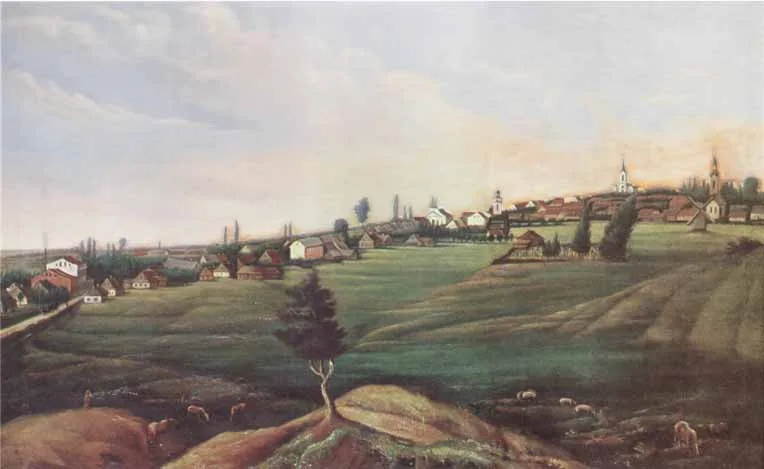
Zduńska Wola first appears in documents in 1314, as a small settlement. For five centuries little happened here - only at the start of the 19th century, thanks to one family of owners, did the little town undergo a rapid transformation that is still visible today in its architecture and identity.
The owners who bet on industry
From the start of the 18th century Zduńska Wola belonged to the Złotnicki family, of the Prawdzic coat of arms. It was, however, only Stefan Prawdzic-Złotnicki, owner of the estate at the turn of the 18th and 19th centuries, who decided to take a step that changed the town's fate: instead of sticking to the traditional, agricultural model of an estate, he chose to bring in skilled craftsmen - weavers.
From around 1817-1818 Złotnicki ran a settlement campaign, bringing cotton and linen weavers to Zduńska Wola from Wielkopolska, Silesia, the Bohemian lands, Saxony and Prussia. Settlers received plots of land and help building their workshops, and in return built up textile production in the town on a scale unseen there before.
Where the name "Town of Weavers" came from
The effects of this settlement policy were visible enough that in 1825 Zduńska Wola was granted town rights - already as a centre where the textile craft was the basis of the economy, not an addition to farming. This is the origin of the nickname "Town of Weavers", which the town still carries today, including in the names of its streets and squares.
The growth of Zduńska Wola in the 19th century ran parallel to what was happening on a much larger scale in Łódź at the same time - the towns of the region competed with and complemented each other as textile centres of the Kingdom of Poland, though Zduńska Wola never reached the size of its big neighbour.
Traces of the Złotnicki family in the town
The most tangible trace of the town's founders is the Dworek Złotnickich (Złotnicki Manor) - the family's former residence, today a landmark that recalls that behind the town's industrial success stood the specific, well-documented history of one family, not an anonymous economic process.
The history of the weaving settlement, the growth of industry and the everyday life of the town's former residents can today be traced at the Muzeum Historii Miasta (Town History Museum), which gathers mementos of old Zduńska Wola - from documents to craftsmen's tools.
Weavers still present in the town today
Modern Zduńska Wola recalls its roots in a very literal way - one of the central roundabouts is named Rondo Tkaczy Zduńskowolskich (Zduńska Wola Weavers' Roundabout), and more references to this history can be found around the town, from murals to the names of institutions.
How to explore Zduńska Wola on the trail of the weavers
A walk around the historic centre is best started at the Złotnicki manor, continued through the museum, and finished around the roundabout and the old, post-industrial buildings in the town centre. The whole route takes about two hours at an easy pace. Admission to the museum involves a small fee, and it is worth checking the current opening hours before a visit, as the museum is usually closed on Mondays. You will find a full list of the town's landmarks on the Zduńska Wola page, and more history of the region in the Poznaj Łódź (Discover Łódź) section.

Be the first! Add a comment.
You need to log in to add a comment.
Log in