
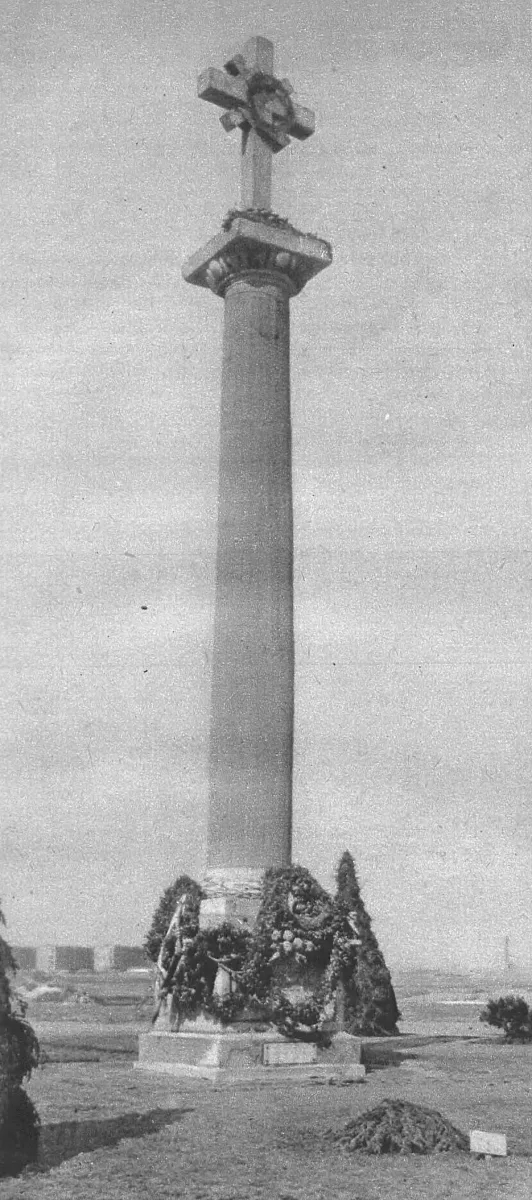
A year after the bloody suppression of the Łódź insurrection of June 1905, the city still lived in the shadow of revolution. On 15 August 1906, a day later remembered as Bloody Wednesday, the Combat Organisation of the Polish Socialist Party carried out a coordinated wave of attacks in a single day in nineteen cities of the Kingdom of Poland - and Łódź, as one of the more important revolutionary centres of those years, was among them.
Context - a year after the Łódź insurrection
In June 1905, Łódź experienced the Łódź insurrection - a bloodily suppressed workers' uprising, during which more than a hundred barricades were raised in the city's streets, and clashes with the tsarist army claimed more than 150 lives. The revolution of 1905-1907, however, did not end with the fall of the insurrection - in the following months, tensions between workers and the tsarist apparatus of repression did not ease, and the PPS Combat Organisation, guided by the spirit of armed struggle, systematically attacked officials of the Russian administration and police.
A coordinated action in nineteen cities
Bloody Wednesday was one of the largest and best-coordinated combat actions of the period - within a single day, PPS fighters attacked around 80 Russian officials across the entire Kingdom of Poland: policemen, gendarmes and agents of the Okhrana, the Russian secret political police. The total number of dead and wounded resulting from this one-day wave of attacks exceeded a hundred people. Before the action, the Combat Organisation issued a proclamation to Russian soldiers, announcing that the strikes would be aimed solely at the most hated executioners and informers, not at rank-and-file soldiers - this was meant to limit the risk of mass retaliation against the civilian population.
The Łódź episode of the action
In Łódź, the activities of the PPS Combat Organisation were directly led by Józef Montwiłł-Mirecki, one of the party combat unit's commanders, known for organising earlier actions against the tsarist administration in the city. The attacks in Łódź followed the same pattern as in other cities - bomb attacks on police and gendarmerie posts, aimed at specific officials associated with the repression of workers after the Łódź insurrection a year earlier.
What Bloody Wednesday tells us about the 1905-1907 revolution
The events of August 1906 show that revolutionary tensions in Łódź and the whole Kingdom of Poland did not die down with the suppression of the Łódź insurrection, but continued for over a year, taking the form of organised underground struggle. This is an important, if lesser-known, chapter of the city's history, completing the picture of Łódź as one of the main centres of the 1905 revolution in the Kingdom of Poland, alongside Warsaw and the Dąbrowa Basin. More on this period can also be found among the preserved monuments of the former factory district. For the record, it is worth adding: the name Bloody Wednesday is also used in historiography for other, earlier events in Warsaw from the same revolutionary period, so when researching further it is worth specifying the year and the city.
Where to look for traces of those events
Unlike the Łódź insurrection of 1905, which has its lasting commemoration in the city's space, Bloody Wednesday has not received a separate monument or plaque in Łódź - the source material does not clearly indicate exactly where in the city the individual attacks took place, which makes it difficult to mark out a specific walking route. The context of the era is best understood by placing this topic alongside the history of the whole 1905 revolution in the region and the realities of the factory district where most Łódź workers were employed at the time - today this is the area of the former Poznański complex, known as Manufaktura, where thousands of people directly involved in the revolutionary events of those years worked.
A good starting point for a walk through the historic centre of revolutionary Łódź also remains the area of the Old Market Square (Stary Rynek), the heart of the city even before its industrial boom, where in the 19th and early 20th centuries the life of the poorest residents was concentrated - those hit hardest by the repression that followed the Łódź insurrection.
More material on the city's history from this period can be found in the "Poznaj Łódź" (Discover Łódź) section.
Be the first! Add a comment.
You need to log in to add a comment.
Log in