
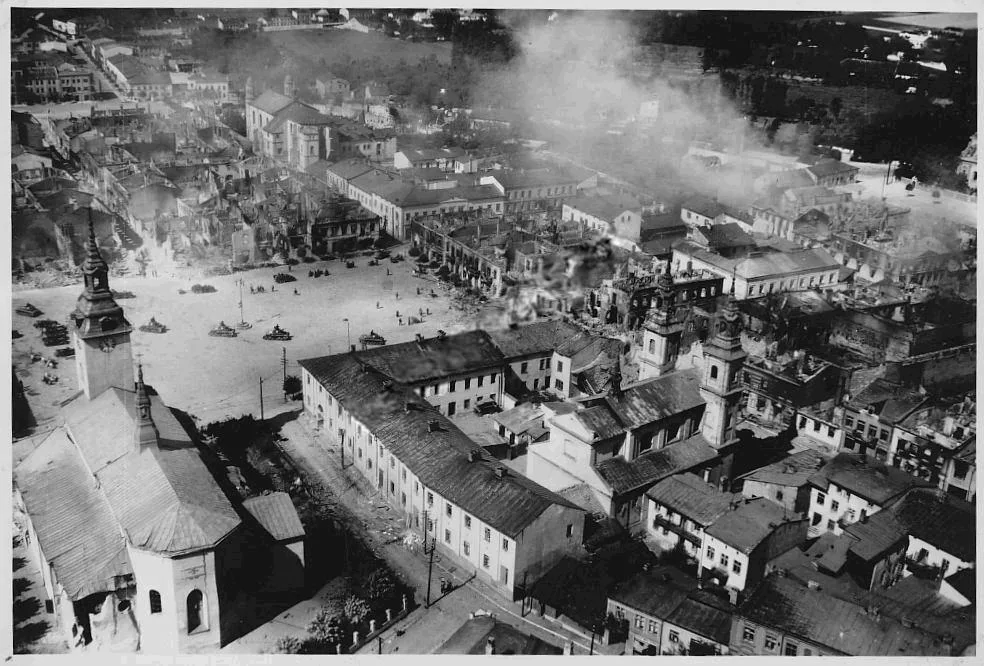
Wieluń, a small county town at the southern edge of today's Łódź region, had no military garrison and no strategic significance. Despite this, it became one of the first targets of the German air attack in 1939 - even before Germany had formally declared war on Poland.
What exactly happened on 1 September 1939?
Early in the morning, between 4:40 and 5:40 Polish time, German Ju 87 dive bombers attacked Wieluń. The exact time is still disputed among historians - partly because of the different time systems used on the two sides of the border at the time. The raid continued, with breaks, into the afternoon.
What was destroyed?
Bombs hit, among other places, the All Saints' Hospital, even though the building was clearly marked with a Red Cross sign, as well as the town centre together with the market square and the 14th-century Church of St. Michael. The synagogue was also destroyed - today a plaque marks the spot where it once stood. Estimates of the destruction of the town itself vary by source, from around 70 to over 90 percent of the built-up area.
How many people died - why do the numbers differ so much?
This is one of the most disputed elements of the history of the Wieluń bombing. Media reports and some popular publications cite figures of around 1,200 or even over 2,000 victims - historians, however, assess that these may stem from errors or from propaganda accounts from years past, and lack solid source confirmation. The Institute of National Remembrance, in a 2004 study, established 127 confirmed deaths in the town itself, while allowing that the real number of victims could have reached several hundred. Historian Mateusz Jan Piątkowski, in a 2013 study, likewise points to a figure of around 127 deaths in the town, noting that higher estimates may combine victims from the whole Wieluń county, not just the town itself. For this reason, the text deliberately avoids giving a single, striking victim count - reliable sources do not agree on one.
Wieluń or Westerplatte - where did the war begin?
Wieluń is sometimes called the place where the first bombs of World War II fell, though historians dispute the exact sequence of events that morning. Some German researchers point out that, at around the same time, around 4:40, an attack on the railway bridge in Tczew was also underway, and that the shelling of Westerplatte by the battleship "Schleswig-Holstein" began chronologically first. Regardless of this dispute, the bombing of Wieluń remains a symbol of an attack on a town with no military value and, to a large extent, on a civilian population.
What can be seen in Wieluń today?
The Old Town in Wieluń, rebuilt after the war, has preserved fragments of its medieval defensive walls and towers. The history of the bombing and the town's wartime fate is presented at the Museum of the Wieluń Land, located in the town centre.
Practical information
The Museum of the Wieluń Land is open on weekdays, and admission is usually charged, at a modest amount - it is worth checking the current price list and opening hours before your visit, as they may change. Touring the exhibition takes about an hour. A walk around the historic part of Wieluń, with the town walls and the memorial plaque marking the former synagogue, adds another 30-40 minutes.
More about the events of September 1939 in the Łódź region can be read in other articles in the Poznaj Łódź section, and the full list of historic sites in Wieluń and the surrounding area can be found in the attractions catalogue.
Be the first! Add a comment.
You need to log in to add a comment.
Log in