
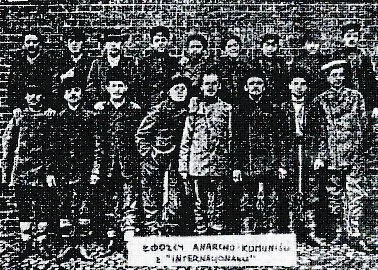
In the spring of 1905, a wave of unrest swept through the Russian Empire, including the Kingdom of Poland, later named the Revolution of 1905. Its trigger was the suppression, in Saint Petersburg on 22 January 1905, of a peaceful workers' demonstration - an event remembered as Bloody Sunday. In Łódź, a city with an enormous working class employed in textile factories, tensions grew over the following months.
How did the clashes begin in June 1905?
On 18 June a military patrol clashed with a procession of workers returning from a countryside outing outside the city. Two days later, on 20 June, the funeral of five victims of that clash was held - around 50,000 people joined the procession. On 21 June, around 70,000 city residents took to the streets, this time in reaction to a provocative rumour.
What happened on the night of 22 to 23 June?
It was this night that went down in history as the "night of barricades". Workers built barriers out of whatever they had at hand - paving slabs, ladder wagons, posts. Some barricades reached almost the height of a tenement building's first floor. The heaviest clashes took place on Piotrkowska street, at the intersection with today's Żwirki i Wigury street (then Karola) and Pusta street.
How many people died - and why do the numbers differ?
Official tsarist authority figures speak of 151 killed (55 Poles, 79 Jews and 17 Germans), 8 wounded and 10 people trampled in the crowd during the period from 18 to 25 June. Secret police reports from the same period, however, give different numbers - on 23 June alone, 164 people were said to have died, with 150 wounded. Some historians estimate the total number of victims at over 200 killed and around 800 wounded over the whole week of clashes.
This discrepancy stems from the chaos of those days - some of the wounded later died at home, without being reported to the authorities, and some bodies never made it into the official statistics. There is no single, fully reliable death toll for the Łódź insurrection - only estimates that vary depending on the source.
How did the fighting end?
On 24 June the cavalry of the tsarist army gained the upper hand, and martial law was introduced in the city. The following day the situation began to stabilise, and on 26 June the factories reopened. The Łódź insurrection was suppressed, but it was the first armed uprising by Poles against tsarist rule on such a scale since the January Uprising of 1863-1864.
Why is this event important for the city's history?
The events of June 1905 show a different face of Łódź than the one known from stories about manufacturers and the "Promised Land". This was working-class, multi-ethnic Łódź - the victims included Poles, Jews and Germans, showing that poverty and exploitation in the factories affected residents regardless of origin. The Łódź insurrection is also sometimes called the first mass workers' uprising of an almost insurrectionary character in the Kingdom of Poland.
Where to look for traces of those events today
There are no physical relics of the 1905 barricades left in the city - the tenement buildings along the route of the fighting were rebuilt or reconstructed in the following decades. Some of the victims, however, rest in the Old Cemetery (Cmentarz Stary) on Ogrodowa street, one of the oldest necropolises in Łódź, where representatives of many faiths and social classes of the city lie buried.
How to walk the route of the fighting today?
The simplest way to explore this part of history is a walk down Piotrkowska street - today the city's main pedestrian promenade, full of cafes and shops, where barricades stood in 1905. The route from Plac Wolności to Aleja Piłsudskiego takes about 40 minutes on foot, and along the way you can stop at numerous atmospheric spots in the centre. The Old Cemetery is free to enter during the gate's opening hours, which usually change seasonally - worth checking before your visit.
More about the history of Łódź at the turn of the 19th and 20th centuries can be read in other texts of the "Poznaj Łódź" (Discover Łódź) section, including about other memorial sites in the city.
Be the first! Add a comment.
You need to log in to add a comment.
Log in