
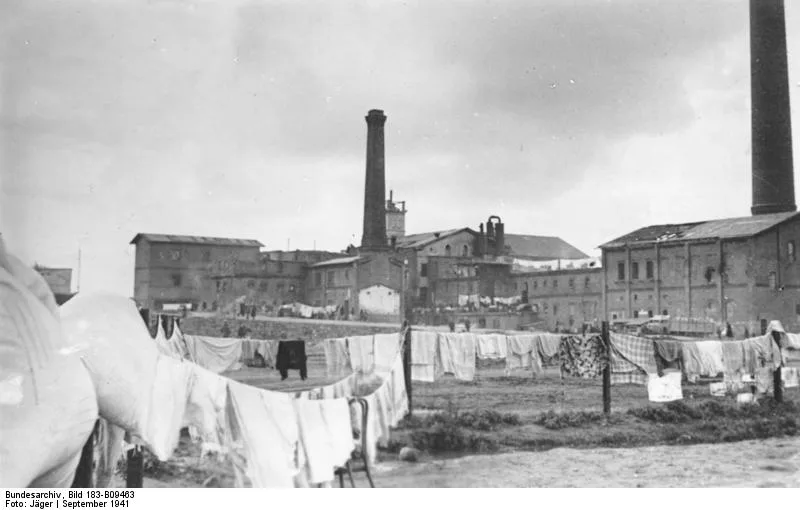
Kutno today is associated with the Battle of the Bzura and the beautiful Saxon Palace in the town centre. Few people know that during the war, on the outskirts of the town, on the site of a disused sugar factory, there was one of the most overcrowded ghettos in the region, a place where living conditions were exceptionally extreme even by occupation-era standards.
The ghetto on the site of the Konstancja sugar factory
On 16 June 1940, the Germans resettled the Jews of Kutno and the surrounding county into a ghetto set up on the site of the disused Konstancja sugar factory. The area, surrounded by a wall and barbed wire, covered only about 5 hectares, and the population density there reached, according to estimates, about 160,000 people per square kilometre, more than in the Łódź ghetto. On such a small area there was one well and only a few toilets for thousands of residents.
In early 1941, a typhus epidemic broke out in the ghetto, after which the occupying authorities sealed it off even further, cutting off contact with the Polish population and access to food even more. Sanitary conditions and hunger meant mortality in the Kutno ghetto was very high even before the deportations began.
Spring 1942 - deportations to Chełmno nad Nerem
In the spring of 1942, the liquidation of the ghetto began. More than 6,000 Jews from Kutno were deported to the Chełmno nad Nerem death camp via the railway station in Koło, where all of them were murdered. This was the end of a Jewish community several centuries old, which before the war had formed a significant part of Kutno's population and economy.
Places of remembrance in Kutno today
In 1992, on the initiative of the Towarzystwo Przyjaciół Ziemi Kutnowskiej (Society of Friends of the Kutno Region), a memorial stone was erected on the spot where the synagogue had stood before the war, destroyed by the Germans in 1941. A year later, in 1993, the same organisation had a commemorative plaque placed on one of the buildings of the former Konstancja sugar factory, marking the spot where the Germans set up the ghetto for the Jewish residents of Kutno. The society also prepared a marked walking route following the traces of the Jews of Kutno, which can be walked independently through the town.
The Saxon Palace - a place that tells more than one story
In the centre of Kutno stands the Muzeum Pałac Saski (Saxon Palace Museum), a building that over its long history hosted, among others, Napoleon Bonaparte, Tsar Alexander I and Henryk Sienkiewicz. Today it houses the Regional Museum in Kutno, whose exhibition also touches on the history of the local Jewish community, a natural place to begin exploring this part of the town's history before setting out along the memory trail itself.
In practice: how to visit the traces of Jewish Kutno
The walking route following the traces of the Jews of Kutno leads through the town centre and the site of the former sugar factory, and can be walked in about two hours, depending on the pace and the number of stops. It is worth starting at the Muzeum Pałac Saski, checking the current opening hours beforehand, as they vary by day of the week and time of year.
The memorial stone on the site of the former synagogue and the plaque at the former sugar factory can be viewed without restriction, as they are in public space. From Łódź, Kutno can be reached by regional train in about an hour, which makes this route a convenient day trip combining history with the historic architecture of the Rynek w Kutnie (Kutno market square).
The wider context of the region's Jewish history can be found in the Łódź Wielu Kultur (Łódź of Many Cultures) series and in the Poznaj Łódź (Discover Łódź) section, including the article on Stacja Radegast, from where residents of the Łódź ghetto were deported along the same road to death as the Jews of Kutno.

Be the first! Add a comment.
You need to log in to add a comment.
Log in