
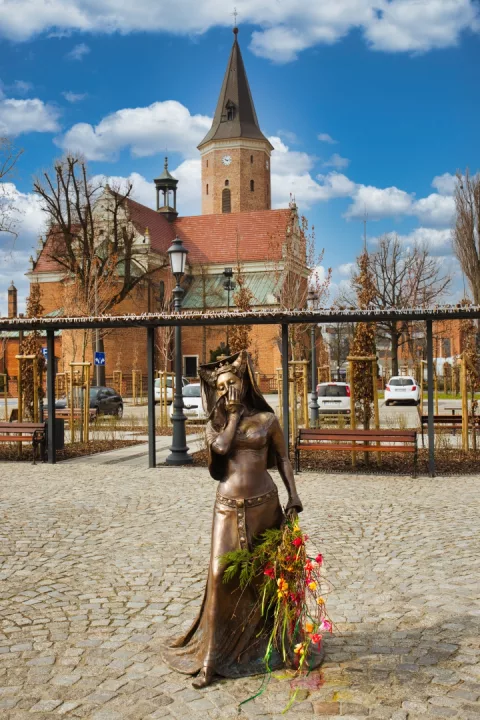
The coat of arms of Pabianice - three golden crowns arranged on a blue field - is one of those symbols around which its own mythology has grown. The legend, repeated in the town for generations, tells of three kings who regularly visited these lands. The real history of the coat of arms is different and, as is often the case, less spectacular than the folk tale.
The legend of the three kings
According to local tradition, the three crowns on the coat of arms of Pabianice commemorate three monarchs said to have visited the town: Władysław Jagiełło, John III Sobieski and a third king whose identity the legend does not specify - different versions of the story name different rulers, and none is certain. It is precisely this uncertainty about the third figure that keeps the legend alive today as a riddle rather than a closed story.
There is indeed a grain of truth in this tale: Władysław Jagiełło visited the area around Pabianice at least twice with his court, and Casimir IV Jagiellon is said to have rested with his wife at the local manor house. Royal visits to the region did happen - it is just that they were not what gave rise to the coat of arms.
What historians say
The oldest known town seal bearing the motif of three crowns dates from 1552, but the coat of arms may have been in use earlier, probably from the 14th century, when Pabianice was granted town rights. Three golden crowns on a blue field are, in fact, the symbol of the Kraków Chapter - the church institution that owned the lands of Pabianice at the time.
The motif of three crowns in church heraldry referred to the Holy Trinity, while also underlining the ambitions of the bishops of Kraków to play a key role in the Kingdom of Poland. In other words, the coat of arms of Pabianice does not speak of visitors to the town, but of its owner. This is a fundamental difference: the legend tells of secular rulers visiting the town from outside, while the facts tell of a church authority that governed the town on a daily basis.
A trace of that dependence can still be seen today in the town's architecture - the old manor house, where representatives of the chapter managing the Pabianice estates once resided, has survived and today houses the Museum of the Town of Pabianice.
Where the name Pabianice really came from
The story of the town's name follows a similarly two-track path. The scholarly version derives it from the name Fabian (Pabian), popular in neighbouring Bohemia - probably from a person bearing this name who founded a settlement here at the turn of the 10th and 11th centuries.
There is, however, a parallel folk version, recorded at the end of the 19th century by the local chronicler Maksymilian Baruch based on local tales. According to it, the original name was Pobawianice or Pobijanice - from the fact that the local dukes are said to have "played" ("bawić się") and "struck down game" ("zwierzynę pobijać") in the forests here, that is, hunted. The sounds of hunting horns and shouts, according to the legend, gave rise to the name of the settlement, which over time became Pabianice.
A town that lives its own legend
Regardless of which version is closer to the truth, both stories - of the three kings and of the town's hunting origins - have become a permanent part of the identity of Pabianice. They are worth knowing precisely as legends: colourful, but not confirmed by sources, unlike the documented history of the Kraków Chapter as the town's actual owner.
A walk through the historic centre is best started at the Old Market Square, where the town's medieval urban layout has survived to this day.
A few hundred metres further stands the Kindler factory owner's residence - an example of a completely different, much later era in the town's history, when Pabianice, like neighbouring Łódź, became a centre of the textile industry.
How to plan a visit
A route linking the market square, museum and historic residences takes about two hours at a relaxed pace. Admission to the museum involves a small fee, and it is worth checking the current opening hours before arriving. A full list of the town's attractions can be found on the Pabianice page, and more legends and curiosities from the region in the Discover Łódź section.
Be the first! Add a comment.
You need to log in to add a comment.
Log in