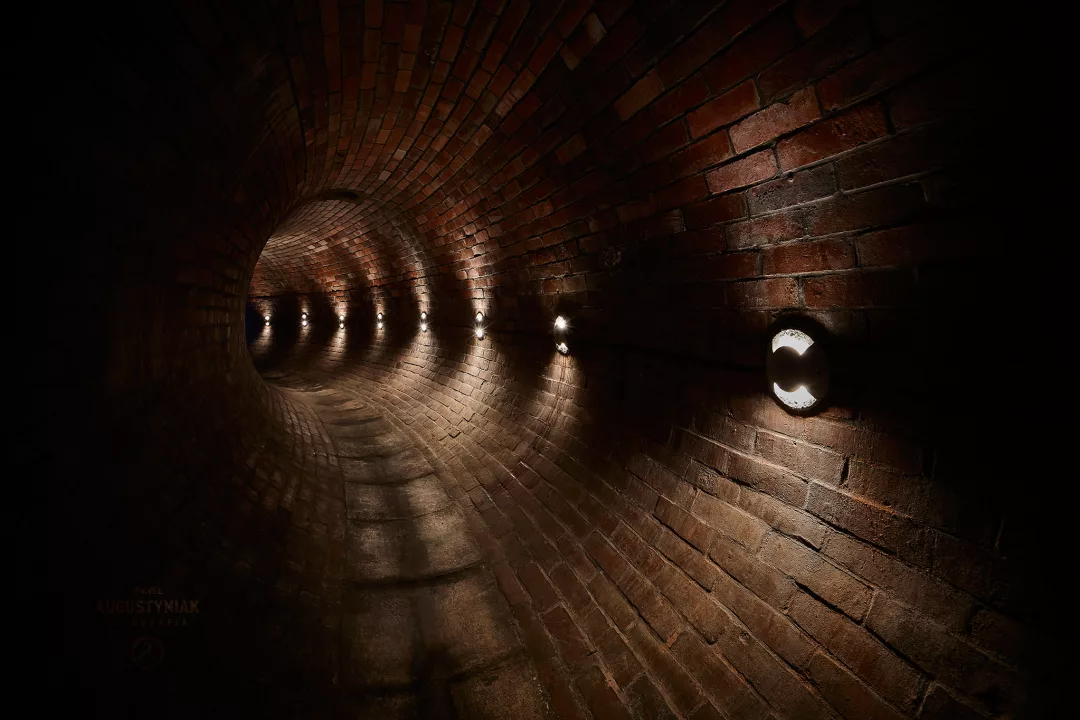
A historic ring-shaped water reservoir, hidden deep beneath Plac Wolności, tells the story of Łódź's sewage and water supply system since the city's industrialisation.
The Dętka Canal Museum is a branch of the Museum of the City of Łódź located in a historic water reservoir in the shape of a torus, hidden beneath Plac Wolności. The museum presents the history of sewerage and water supply in Łódź from the time of its industrialisation, telling a compelling story of infrastructure without which modern cities would be impossible.
The Dętka reservoir was built in 1926 beneath Plac Wolności in Śródmieście, Łódź. The designer was William Heerlein Lindley, the great engineer responsible for all of the city's water and sewerage infrastructure, and the work was supervised by Stefan Skrzywań. The reservoir is ring-shaped (a torus) with a capacity of 300 cubic metres, a length of 142 metres, a height of 187 centimetres and a width of approximately 1.5 metres. It served the function of collecting water for periodic flushing of the sewerage network in the city centre – an engineering solution that made it possible to maintain hygiene and public safety.
The Dętka Canal Museum opened to the public on 30 April 2008, with the official opening of the exhibition taking place the day before, on 28 April. The exhibition design was developed by architect Maciej Słowiński, and the display was curated by Robert Kuśmirowski. The team created a space combining the history of technology with the visitor's experience. The museum's exhibition presents objects, documents and archival photographs illustrating the fascinating development of Łódź's sewerage and water supply network over the course of decades.
The above-ground part of the museum is a modern glass pavilion located in the northern part of Plac Wolności, between the monument to Tadeusz Kościuszko and Nowomiejska street. The glass structure protects the entrance to the underground whilst also drawing on the modern contrast between past and present. All visitors enter through this pavilion and descend into the depths, where at a depth of approximately 5 metres a fascinating world of former Łódź infrastructure awaits them.

Be the first! Add a comment.
You need to log in to add a comment.
Log in