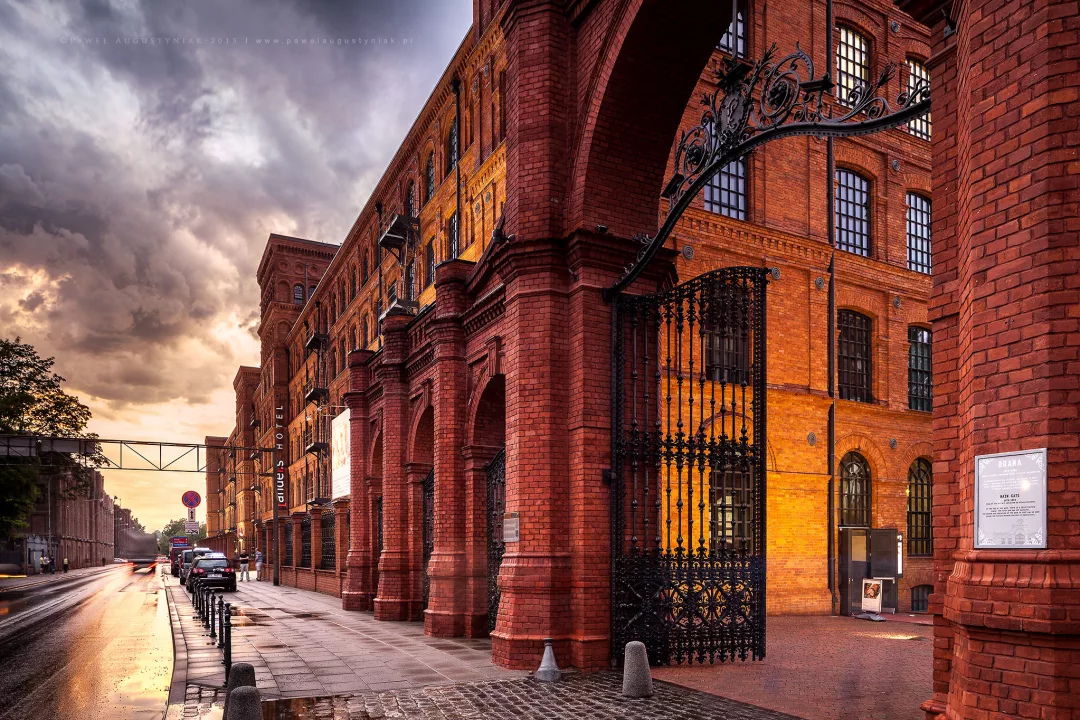
A heritage factory from the late nineteenth century and one of the symbols of Łódź's industrial past. Worth visiting to see the architecture from the city's textile heyday and learn about entrepreneur Israel Poznański's history.
The Israel Poznański Factory on Ogrodowa Street was a fully integrated cotton processing plant, one of the largest in this part of Europe, and today its halls house Manufaktura, museums and a hotel. The complex was built over twenty years according to a design by Hilary Majewski and expanded to nearly thirty hectares. The brick facades of the spinning mill and the factory gate are among the most recognisable elements of Łódź's industrial landscape.
Poznański bought the plot on Ogrodowa in 1871, and factory buildings were constructed in the years 1872-1892.
Fully integrated means that raw cotton came in and finished fabric went out. The site housed weaving mills, a spinning mill, bleachery and finishing works, a dye house, textile printing and finishing departments. This was supported by its own technical and utility infrastructure: a machinery repair and construction shop, a locksmith's workshop, a foundry, a locomotive depot, a gas works, a fire station, warehouses and a railway siding, as well as factory offices and residential buildings for workers. In 1913 the plants employed nearly seven thousand people.
The complex's signature feature is a five-storey cotton spinning mill made of red unplastered brick, stretching along Ogrodowa Street.
It was built in 1877-1878, and the National Heritage Institute dates it to 1878 and records it at Ogrodowa 17. After renovation, the building became a hotel. Both the spinning mill and the factory gate were recognised as historical monuments in 2015. Objects from the complex were entered into the heritage register gradually, between 1971 and 1993.
The plant was nationalised on 19 January 1945 as Cotton Industry Plant number 2.
Later it was named after Julian Marchlevski, and from the 1970s production continued under the Poltex brand. The enterprise was liquidated in 1991 and the complex began to fall into ruin.
The land was purchased by French firm Apsys, which carried out demolition work in the years 1999-2002, and construction of a new development in 2003-2006.
The Manufaktura shopping and entertainment centre opened on 17 May 2006 and was the country's largest revitalisation project. In 2008 a branch of the Museum of Art began operating in the complex, and in 2009 a hotel opened in the former spinning mill. As a result, commercial, museum and hotel functions now coexist in one quarter, while the old walls remain clearly legible.
The museum occupies the building of the former finishing works, was established in 2007, and the exhibition was designed by Nizio Design workshop. The exhibition guides visitors through the fabric production process, from cotton fibres to finished material, and tells the stories of workers and the history of Poznański himself, using films, photographs, documents and architectural plans. Four historic looms are operated by staff every half hour. There is also a cinema room and a viewing platform on the roof with a panorama of the entire complex. Address: Drewnowska Street 58, open Tuesday to Sunday 10.00-18.00, closed Mondays.
The Museum of Art branch at Ogrodowa Street 19 presents a permanent exhibition devoted to the institution's collection, titled Ways of Seeing, as well as temporary exhibitions. Opening hours are Tuesday and Wednesday 9.00-16.00 and Thursday, Saturday and Sunday 12.00-18.00, with extended hours on Friday, closed Mondays. Admission is free on Fridays. Hours may change, so check before your visit.
| Monday | 00:00 – 24:00 |
| Tuesday ← today | 00:00 – 24:00 |
| Wednesday | 00:00 – 24:00 |
| Thursday | 00:00 – 24:00 |
| Friday | 00:00 – 24:00 |
| Saturday | 00:00 – 24:00 |
| Sunday | 00:00 – 24:00 |
Hours per Google Places - may change on public holidays.

Be the first! Add a comment.
You need to log in to add a comment.
Log in