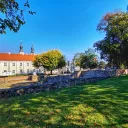
Excavated between 1988 and 1991, the foundations of the 14th-century collegiate church of Saint Michael, destroyed by bombing on 1 September 1939 and blown up by the Germans in 1940, stand as a monument on plac Legionów.
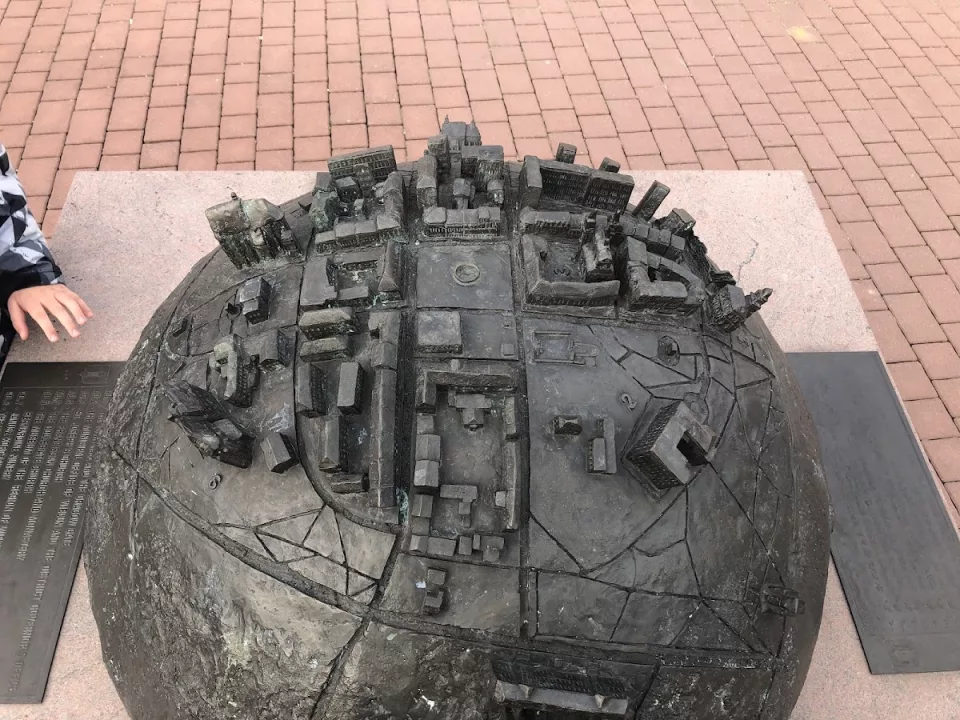
The Monument to the Historic Centre of Wieluń stands on plac Legionów, the former Stary Rynek, in the heart of the city. It is not a classical plinth with a plaque, but the exposed and reconstructed foundations of the 14th-century collegiate church of Saint Michael the Archangel, destroyed during the bombing of 1 September 1939.
The temple was probably built at the turn of the 13th and 14th centuries, and the first written mention of it dates from 1308. In 1419 the church was elevated to the status of a collegiate church, after this rank was transferred from the nearby Ruda. In the 16th century it was among the most impressive temples in Poland, with dimensions of 48.5 metres in length and 25.5 metres in width, reflecting Wieluń's status as an important ecclesiastical centre of the region.
In 1824 Archbishop Ignacy Raczyński abolished the collegiate status by decree, so the temple reverted to the rank of an ordinary parish church. In 1858 a fire damaged the building, after which it was rebuilt with a new tower added; in 1862 three bells were installed, and in 1893 a tower clock. Despite losing its collegiate title, the church remained an important feature in the city's landscape until 1939.
The bombardment of Wieluń began around 4:40 Polish time, before dawn, when German Ju 87 Stuka aircraft attacked the city. Polish historiography recognises this raid as the first bombing of the Second World War, although German historians point to an earlier attack on bridges in Tczew. The Luftwaffe dropped 380 bombs on the city with a total mass of 46 tonnes, and the raids continued with breaks until 14:00.
Wieluń had no significant military targets in 1939, yet approximately 70-75 per cent of the buildings were destroyed. Bombs consumed, among other things, the Hospital of All Saints and a synagogue from 1842. The collegiate church of Saint Michael was severely damaged during the raid, and in the spring of 1940 the Germans finished it off, blowing up the remains and dismantling the building to its foundations.
The exact number of those killed remains a matter of dispute among historians to this day. Contemporary research by the Institute of National Remembrance from 2004 points to around 127 confirmed victims, whereas older, post-war estimates from the Polish People's Republic period spoke of between 1200 and 2169 killed. The discrepancy stems from methodological differences in counting losses, and the Institute's findings are today considered more reliable.
Between 1988 and 1991 archaeologists excavated the remains of the collegiate church and reconstructed their layout, so today the outline of the former walls and foundations can be seen. The place became a space of remembrance, where every year on 1 September patriotic anniversary ceremonies are held to commemorate the first day of the war. Twice, in 1995 and in 2004, Archbishop Stanisław Nowak announced plans for its reconstruction on the ruins of the church, although the building has not been restored to its original form to this day.
The former Stary Rynek, today plac Legionów, remains the central point of Wieluń, around which commerce and city life revolve. The church foundations stand in the middle of this space as a constant reminder of September 1939, alongside everyday street traffic and shops. For visitors, it is a place where the history of the most tragic day in the city's past is visible to the naked eye, without the need to enter any museum.

Be the first! Add a comment.
You need to log in to add a comment.
Log in