The synagogue on Wodna Street is a historic building that forms an important part of Sieradz's history. It is worth visiting to learn about synagogue architecture and the history of the city's Jewish community.
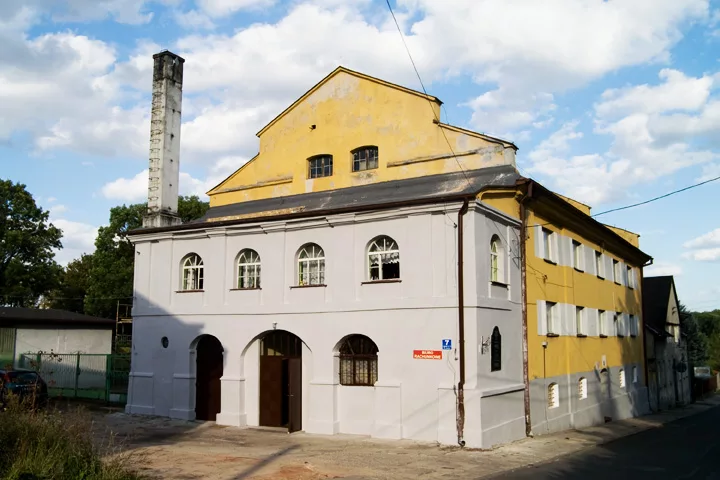
The synagogue at ulica Wodna 7 in Sieradz is a building that survived the war but lost its function and some of its historic features. Services were held here until 1939; today it houses offices and craftspeople's businesses, and a plaque on the external wall commemorates the district's former residents.
The synagogue was built in 1819-1824, probably to a design by Hilary Szpilowski, an architect working in the Kingdom of Poland at the time. The brick building was laid out on a rectangular plan with an annex on the west side, which contained the entrance hall. The interior had rich furnishings: an elaborate neoclassical frame for the aron ha-kodesh, the cabinet for Torah scrolls, and an octagonal raised bimah. A ritual bath was located nearby, so this was an entire quarter of religious life rather than a single building. Around 1850, the cantor here was Lejzer Perelmuter, originally from Lithuania, author of religious songs and a book on Talmudic themes, and father of rabbi and member of the Constituent Sejm Abraham Cwi Perlmutter.
During the German occupation, the synagogue was devastated and then rebuilt for office use, causing the building to lose some of its architectural features. In spring 1940, the Germans created a ghetto around ulica Wodna, which also included ulica Sukiennicza, ulica Rybna and ulica Zamowa. Around 2,500 to 3,000 people lived there in appalling sanitary conditions and with starvation rations. The liquidation of the ghetto began on 24 August 1942. Jews were driven to the church of Saint Stanisław at the Dominican convent, and from 28 August onwards were transported by lorry to the extermination camp at Chełmno nad Nerem. Before the war, Sieradz had around 10,000 inhabitants, of which approximately 2,600 were Jewish.
After the war, the building remained in the hands of secular users. It housed offices and craftspeople's businesses, and a congregation of the Christian Church Jesus Lives also met here. On 17 April 2014, the former synagogue partially burned down. In 2007, on the 65th anniversary of the liquidation of the ghetto, a granite plaque commemorating the Jewish inhabitants of Sieradz was unveiled on the wall of the building. During Sieradz's Days of Judaism, Michael Schudrich, Chief Rabbi of Poland, held prayers in this place.
Another important place is the Jewish cemetery on present-day ulica Zakładników, established in 1804 and one of the oldest in Poland. The Germans broke up the gravestones and used them as building material, among other things to harden the street and build steps at Krakowskie Przedmieście, which were demolished in 2011. A memorial obelisk stands in the cemetery in honour of twenty hostages shot by the Germans on 14 November 1939. The history of the city and region is presented by Muzeum Okręgowe w Sieradzu in the Dominican convent buildings.
| Monday | 00:00 – 24:00 |
| Tuesday ← today | 00:00 – 24:00 |
| Wednesday | 00:00 – 24:00 |
| Thursday | 00:00 – 24:00 |
| Friday | 00:00 – 24:00 |
| Saturday | 00:00 – 24:00 |
| Sunday | 00:00 – 24:00 |
Hours per Google Places - may change on public holidays.

Be the first! Add a comment.
You need to log in to add a comment.
Log in