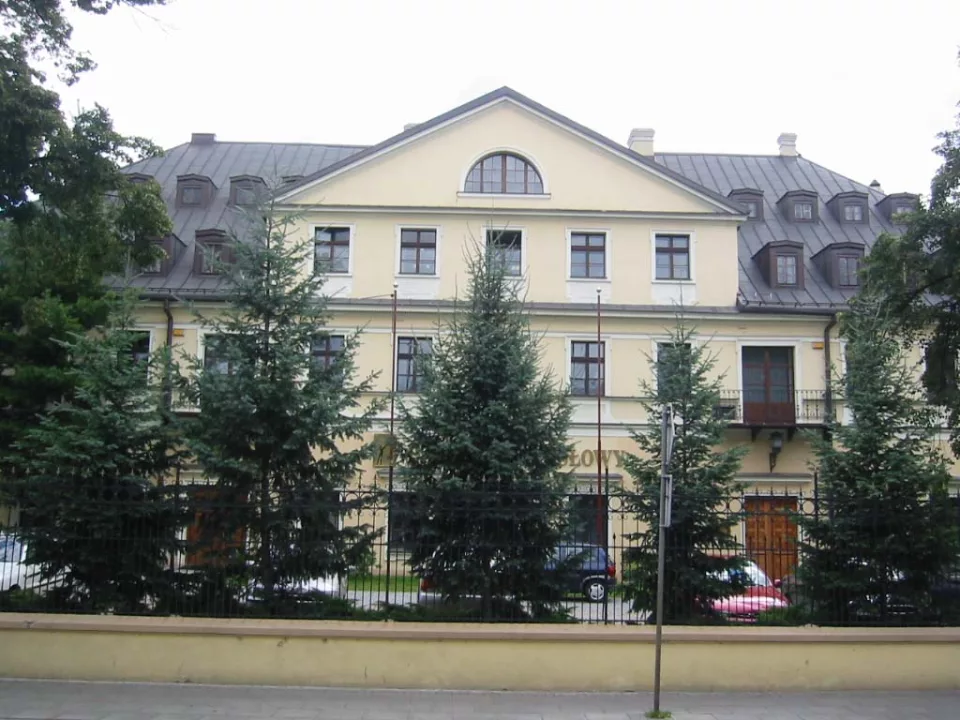
A classicist building from 1828-1829, once owned by industrialist Tytus Kopisch and one of Łódź's oldest surviving industrial structures, now privately owned and closed to visitors.
Bielnik Tytusa Kopischa is a two-storey building at Tymienieckiego 5 on Osiedle Katedralne [Cathedral Estate], one of the oldest preserved industrial structures in Łódź. It was built in the early years of Łódź's industrial development and survived successive owners, wars and political changes, retaining its neoclassical form from the 1820s.
The original building on this site was erected by the authorities of the Kingdom of Poland in 1825 with a linen manufactory in mind. The present neoclassical structure dates from 1828–1829. In 1828, entrepreneur Tytus Kopisch purchased the property on what is now Tymienieckiego Street, then called Emilia Street, from Daniel Ill. The deed of sale described the property as two single-storey houses with cellars forming a single unit.
Kopisch, financially supported by the government, brought linen weavers from Silesia to Łódź and built seventeen wooden single-family houses for them. His workshop ran a complete cycle of linen processing, including bleaching and finishing of fabrics, and was one of the larger linen enterprises in the Kingdom of Poland. After the November Uprising the firm declined, and in 1847 Kopisch sold the enterprise and returned to his homeland.
In 1874 the owners became Henryk and Jakub Peters, and from the 1870s onwards, more precisely from 1878, the building belonged to Karol Wilhelm Scheibler, one of Łódź's largest manufacturers. Later the building passed to Industrial Bank S.A., and from 2004 to Getin Bank S.A. In 2006 the city of Łódź repurchased it, and in September 2017 it became the property of the private company Hocan Estate. The building's current function following this transaction has not been determined; the object is not open to visitors.
It is a neoclassical building with a mansard roof and a usable floor area of 2,179 square metres, with a central section crowned by a third storey and a tympanum. It is listed in the monuments register under numbers 25/1/8 of 24 February 1964 and A/8 of 20 January 1971. It is considered the oldest preserved textile industry building in Łódź, though the name "bleachery" is misleading: according to historical sources the building never actually served this function in the strict sense. Nearby, on the same street, stands Willa Grohmana, another manufacturer's residence from this period of Łódź's development.


Be the first! Add a comment.
You need to log in to add a comment.
Log in