
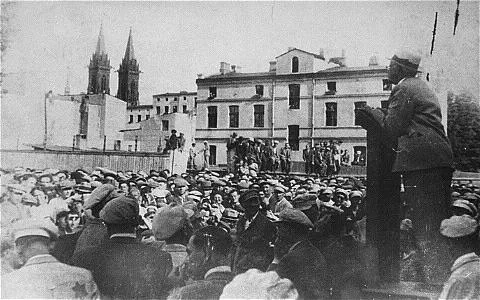
In October 1939, the Germans appointed Chaim Mordechaj Rumkowski chairman of the Council of Elders of the Jewish community of Łódź, and from 1940 - Eldest of the Jews in the Łódź ghetto, also known as the Litzmannstadt Ghetto. He held this position until the ghetto's liquidation in August 1944. He remains one of the most disputed figures in the history of occupied Łódź - historians still disagree on how to judge his rule.
Power in a closed city
Rumkowski built an administrative structure in the ghetto that resembled a miniature independent state. He introduced his own currency, the so-called rumki, and postage stamps bearing his own likeness. He travelled around the ghetto in a horse-drawn carriage, which some prisoners saw as a sign of megalomania in the exercise of power over people who had no influence at all over his decisions.
At the same time, it was under Rumkowski that the Litzmannstadt Ghetto became the largest centre of forced labour in occupied Poland - dozens of workshops operated there producing goods for the German military. This strategy, known as "rescue through work", assumed that as long as the ghetto remained economically useful to the Germans, its residents had a chance to survive.
Cooperation in the deportations
Rumkowski took part in organising the deportation of ghetto residents to the death camps, handing the Germans lists of people selected for transport. The best known and most painfully remembered moment of his leadership is the speech he gave on 4 September 1942, during the so-called Gehsperre (Great Deportation Action), a roundup aimed at children, the elderly and the sick.
They demand that we give up what we hold most precious, our children and our elders. [...] At my age, I must stretch out my hands and beg: brothers and sisters! Give them to me! Fathers and mothers, give me your children!
The deportation carried out during the Gehsperre lasted about a week and involved around 15,000 people taken from the Litzmannstadt Ghetto to the Chełmno nad Nerem death camp. Rumkowski argued that giving up part of the population would allow the rest of the ghetto to be saved - a decision that remains one of the most morally difficult episodes in the history of the Holocaust.
Collaborator, or a man in an impossible situation
The dispute over how to judge Rumkowski has continued since the end of the war. Some historians see him as a collaborator who cooperated with the Germans in organising the Holocaust in order to keep his own position and privileges. Others point out that the "rescue through work" strategy genuinely prolonged the existence of the Łódź ghetto - it survived longer than any other ghetto on Polish soil, which meant part of its residents lived to see liberation. Neither judgement is clear-cut, and Rumkowski's decisions were made in a situation where every choice led to someone's death.
Death in Auschwitz
When the Germans began the final liquidation of the Litzmannstadt Ghetto in the summer of 1944, Rumkowski was deported together with the remaining residents to Auschwitz-Birkenau. He died there at the end of August or the beginning of September 1944. The exact circumstances of his death are not clearly confirmed - some accounts speak of him being killed by fellow prisoners who recognised him as the former ghetto leader, other sources do not specify the details. Given the lack of clear confirmation, these accounts should be treated with caution.
Places connected with this history
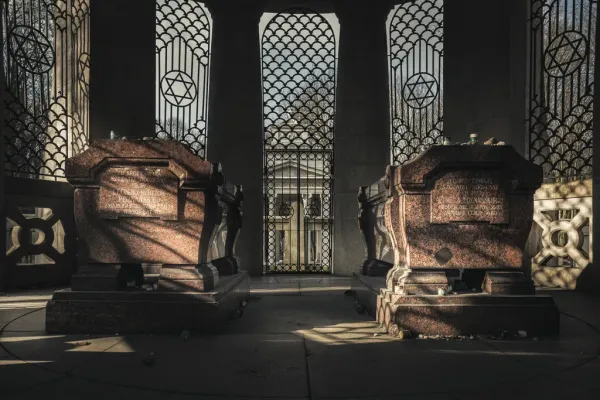
Rumkowski's story is best explored together with the history of the places he ruled over. Stacja Radegast is the point from which the deportation transports he directed departed. At the New Jewish Cemetery on ulica Bracka rest around 45,000 people who died in the ghetto during its existence. The Park Ocalałych (Survivors' Park), in turn, commemorates those who saved Jews against the occupier's policy, standing in contrast to the stance Rumkowski represented.
More on the history of the Łódź ghetto and the places connected with it can be found among the museums of Łódź, and the wider historical context of the city is gathered in the Poznaj Łódź (Discover Łódź) section.
Be the first! Add a comment.
You need to log in to add a comment.
Log in