
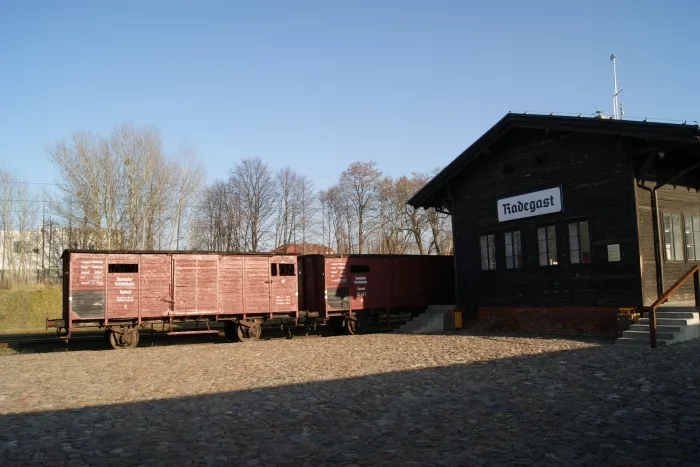
On the outskirts of the Marysin district, on today's aleja Pamięci Ofiar Litzmannstadt Getto, stands a small building that once served as a freight station. Before the war it was an ordinary railway siding. During the occupation it became the place through which most residents of the Łódź ghetto passed on their way to the death camps.
From a freight siding to the ghetto's transfer point
When the Germans set up a ghetto for the Jews of Łódź in the Bałuty district in February 1940, Stacja Radegast, lying right on its border, took on a new role. From 1940 it was the point through which food supplies and raw materials for the factories reached the ghetto, and from which goods made by the prisoners were shipped out.
The station's name comes from the former German name for this part of the city - Radogoszcz was called Radegast in German.
The station as a place of deportation
From January 1942, the station's role changed irreversibly. It was from here that railway transports began departing, carrying ghetto residents to the death camp at Kulmhof, that is Chełmno nad Nerem, and from 1944 also to Auschwitz-Birkenau. Over the following two and a half years, most of the 160,000 people who were held in the Litzmannstadt Ghetto before and during the war passed through Stacja Radegast.
Many of those who boarded the freight wagons here did not know where they were really going. Rumkowski, chairman of the ghetto's Council of Elders, presented the deportations as departures for work, one of the reasons why, over time, the station became a symbol of the deception the Germans used against the victims of the Holocaust at places of remembrance across the city.
The monument and museum today
In 2004, on the 60th anniversary of the liquidation of the Łódź ghetto, the Monument to the Holocaust of the Litzmannstadt Ghetto was unveiled on the station grounds. Today the former station building is a branch of the Museum of Independence Traditions in Łódź. Visitors can see an exhibition devoted to the history of the ghetto and the Tunnel of the Deportees, which displays transport lists bearing the names of the victims.
How to visit Stacja Radegast
The museum is open Monday to Thursday from 10:00 to 16:00, and on Saturdays and Sundays from 10:00 to 17:00. It is closed on Fridays. An admission ticket costs about 10 zlotys, and entry is free on Wednesdays; discounts also apply for pupils, students and seniors, among others. A guided tour costs an extra fee of about 30 zlotys - it is worth booking in advance, especially for organised groups.
You should allow at least an hour for a relaxed visit to the exhibition and the tunnel. This is not a place to rush through between other stops on an itinerary.
Why it is worth coming here
For many visitors, especially from abroad, Stacja Radegast is the first stop on the trail following the history of the Łódź ghetto. Unlike many places of remembrance in Poland, the history here is told plainly, without tourist rhetoric: documents, transport lists, photographs. This is a place that calls for the visitor's attention, not entertainment.
Other places on the memory trail
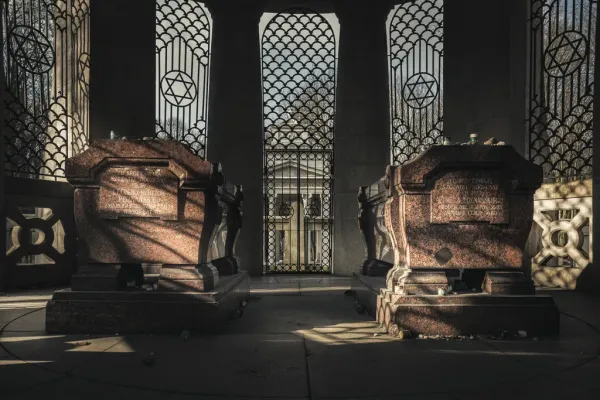
Stacja Radegast connects well with other points linked to the history of the Łódź ghetto. In the city centre, it is worth visiting Park Ocalałych (Survivors' Park) with its monument to the Righteous Among the Nations, and, on ulica Bracka, the New Jewish Cemetery with the Ghetto Field, where about 45,000 people who died in the ghetto are buried. The only pre-war synagogue to survive the occupation can be seen at the Synagoga Reicherów (Reicher Synagogue) in the city centre.
More places connected with the history of 20th-century Łódź can be found among the museums of Łódź, and the wider historical context of the city is gathered in the Poznaj Łódź (Discover Łódź) section.
Be the first! Add a comment.
You need to log in to add a comment.
Log in