
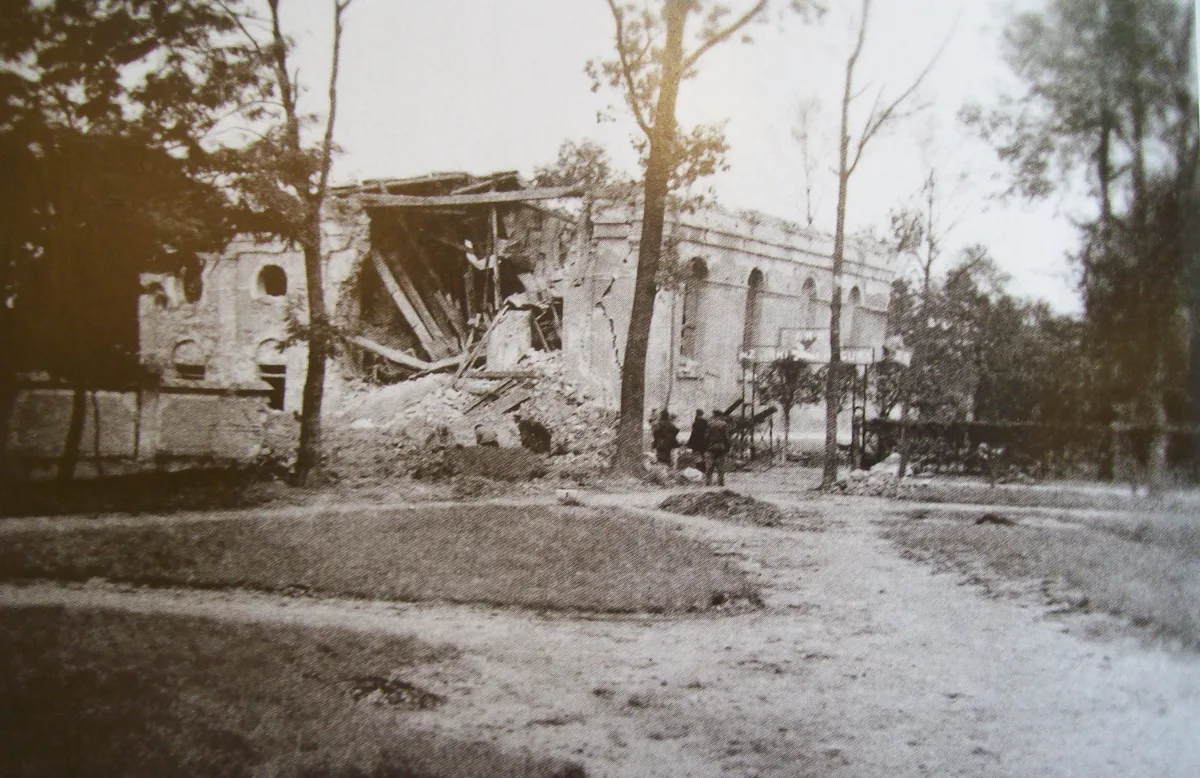
Wieluń is known to anyone with even a passing interest in the history of the Second World War - it was here, in the early hours of 1 September 1939, that the Luftwaffe carried out one of the first bombing raids of the September campaign, destroying as much as three-quarters of the town's buildings. It is less often mentioned that on that same day the synagogue also disappeared - the centre of religious life for a third of pre-war Wieluń's residents.
A town where one in three residents was Jewish
In the 1930s Jews made up about a third of the residents of Wieluń - at the end of 1938 that was 5238 people. The town's Jewish community had a long history and its own religious institutions, and the synagogue near today's Farna street, built between 1840 and 1842, was one of the finest buildings of its kind in the former Kalisz voivodeship.
The first day of the war, the first destruction
In the early morning of 1 September 1939, German aircraft bombed the town, which then had about 15 thousand residents and lay less than 30 kilometres from the border with the Third Reich. Other historic religious buildings were also destroyed at that time - among them the 14th-century parish church and the former Augustinian monastery. The synagogue, built on the site of an even older temple, was destroyed by bomb blasts that same day, and its ruins were demolished soon after.
It is a coincidence of dates that gives this story an especially powerful meaning: the destruction of Jewish Wieluń began literally on the first day of the war, before anyone had even managed to understand what was happening. After the war the synagogue building was not rebuilt, and the site where it stood became part of the neighbouring park.
What still recalls that history today
On the site of the former synagogue there now stands a commemorative plaque, explaining what once stood there and what it was used for. It is one of the few material traces of Wieluń's Jewish history to survive to our times - most of the buildings of the former Jewish district disappeared along with the rest of the town destroyed in 1939.
Muzeum Ziemi Wieluńskiej
The history of the town, including the events of 1 September 1939, can be explored in detail at the Muzeum Ziemi Wieluńskiej (Museum of the Wieluń Land), which documents the fate of the town and the region - both the tragedy of the first day of the war and the earlier, multicultural history of Wieluń.
In practice: how to plan a visit
The commemorative plaque on the site of the former synagogue can be viewed at any time, since it stands in public space near the town centre. It is worth visiting the Muzeum Ziemi Wieluńskiej first, to understand the broader context of the events of 1939 - about an hour is enough for a visit, and it is worth checking the current opening hours before travelling, as they vary by day of the week.
From Łódź, Wieluń can be reached by car in under an hour and a half - it is the furthest south-westerly point in this series of articles about the region. It is worth combining the visit with a walk around the historic town centre, largely rebuilt after the wartime destruction.
You will find a broader context of the Jewish history of the Łódź region in the Łódź Wielu Kultur (Łódź of Many Cultures) series and in the Poznaj Łódź (Discover Łódź) section, including in the article about Stacja Radegast (Radegast Station) in Łódź.
Be the first! Add a comment.
You need to log in to add a comment.
Log in