
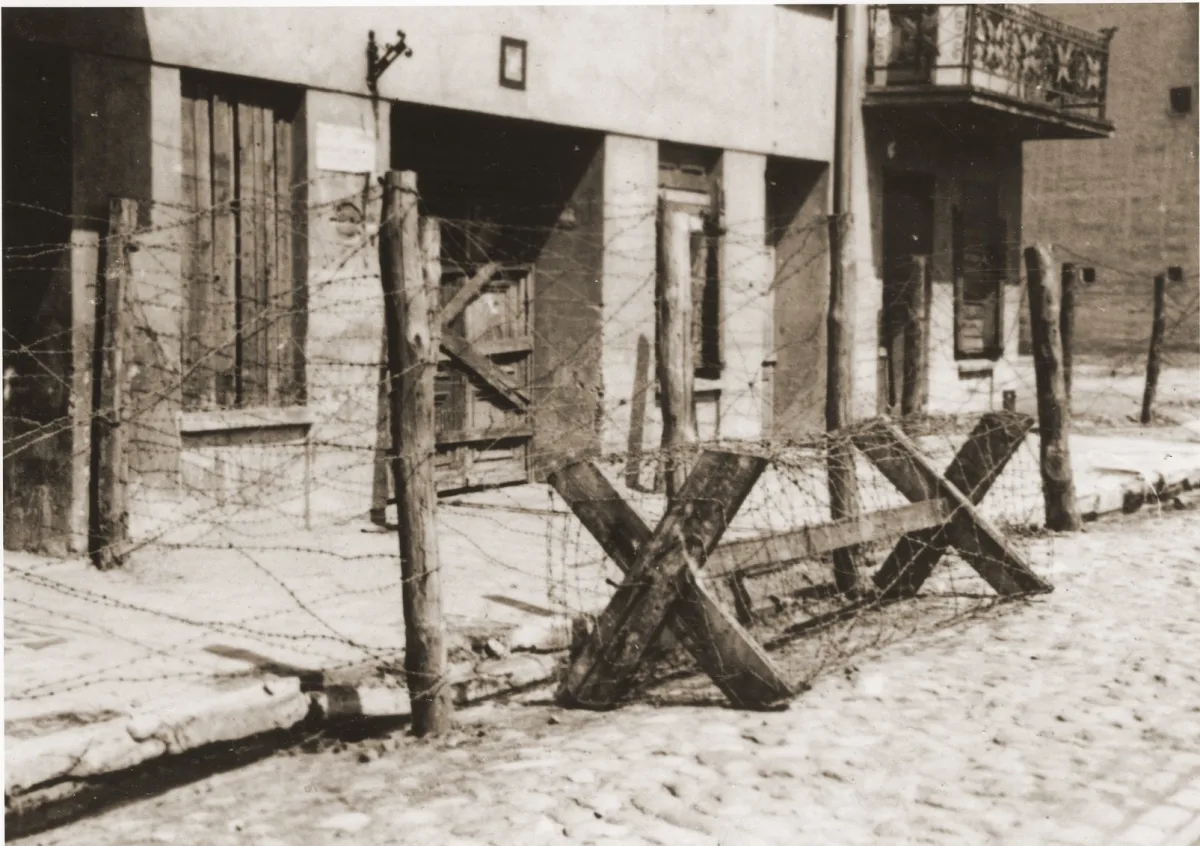
In November 1941, transports arrived in Łódź, renamed Litzmannstadt by the Germans, that no one in the city expected. Instead of more residents for the Jewish ghetto, Roma and Sinti from the Austrian border region arrived at the railway siding. This was the beginning of a camp that few people know about today, but which historians call the first place of confinement set up by the Germans exclusively for Roma in occupied Poland.
Where the camp's prisoners came from
Between 5 and 9 November 1941, 5,007 people were transported to Łódź from Styria and Lower Austria, including the Burgenland region on the Austrian-Hungarian border. Among the deportees were 1,130 men, 1,188 women and as many as 2,689 children - more than half the transport were the youngest. The Germans were acting as part of a broader campaign to remove Roma from territories annexed to the Reich, and Łódź, where a Jewish ghetto had already existed since February 1940, became the destination for another group of people marked for isolation.
A separate ghetto within the ghetto
The camp for Roma, called by the Germans the Zigeunerlager, was set up on a separate section of the Łódź Ghetto, in the area of today's Wojska Polskiego, Obrońców Westerplatte, Starosikawska and Głowackiego streets. The area was fenced off from the rest of the ghetto with a fence and barbed wire, and it was supervised by the German police, although formally the camp was also partly under the Jewish ghetto administration led by Chaim Rumkowski, which the Germans obliged to supply the camp with food and sanitary care. In practice this meant that the Jewish population of the ghetto, itself living in extreme poverty, had to share its already minimal resources with a second group of prisoners.
Conditions in the camp were catastrophic from the very first days. Prisoners were crammed into empty, unheated buildings, without enough toilets or access to water. There was a shortage of food, medicine and fuel - and the nights of November and December 1941 were freezing.
Typhus epidemic
Extreme overcrowding, lack of hygiene and hunger quickly led to an outbreak of epidemic typhus. The disease spread rapidly under conditions where it was impossible to isolate or treat the sick. As a result of the epidemic, more than 700 people died - mostly children and the elderly, the weakest against hunger and cold. The death rate in the Gypsy camp was, during this period, one of the highest of all places of confinement in occupied Łódź. A similar fate, though in different circumstances, later befell the Łódź prisoners of the Radogoszcz prison, where in January 1945 the Germans massacred prisoners shortly before leaving the city.
Liquidation and deportation to Chełmno
The epidemic became a pretext for the Germans to quickly liquidate the camp. From 5 January 1942, prisoners began to be transported to the Kulmhof extermination centre, that is Chełmno nad Nerem - the same place to which transports from the Jewish ghetto were also directed in the following months. By 12 January 1942, the camp had ceased to exist. All its prisoners who survived the epidemic were murdered in the gas vans at Chełmno. No one from the November transport lived to see the end of the war.
Its place in the history of the Łódź Ghetto
The history of the Gypsy camp remains less known than the fate of the Jewish ghetto, although the two places were separated by only a few streets and existed side by side for less than three months. Today the site of the former camp is an ordinary residential part of Łódź - there is no separate museum or permanent exhibition devoted solely to this history. The context of those events is presented by the permanent exhibition at Radegast Station, from where transports departed for the extermination camps, and by the collections of the Museum of Independence Traditions in Łódź, which document various forms of the German occupation of the city.
For those who want to broaden their visit with more context on the history of the Łódź Ghetto, a good starting point is also the Survivors' Park, dedicated to the memory of people who saved Jews during the occupation, and a walk through the Jewish cemetery, where victims of the ghetto were buried during its existence.
What to know when planning a visit
The site of the former Gypsy camp lies within the former Łódź Ghetto, today an ordinary residential district - there is no dedicated visitor route or information boards at every location. The best starting point is Radegast Station, from where marked routes lead through the traces of the Łódź Ghetto, including the story of the fate of the Roma and Sinti. Admission to the station is free, and guided tours are available for a fee with advance booking. It is worth setting aside at least two to three hours for a walk through these places, so as not to rush through them. More places connected with the city's history can be found in the Discover Łódź section.
Be the first! Add a comment.
You need to log in to add a comment.
Log in