
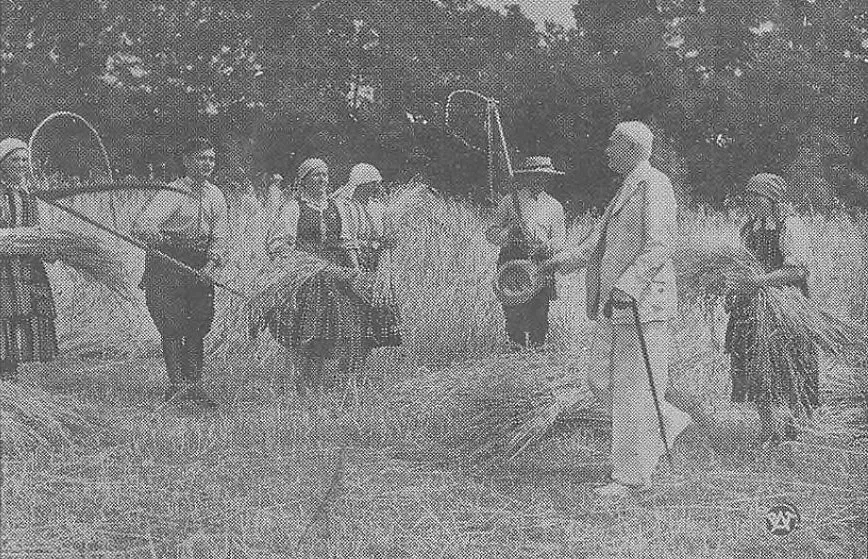
Before Spała became a tsarist, and then a presidential stronghold, it was above all a village among the forests along the Pilica river. It was here, surrounded by a former hunting residence, that in 1927 President Ignacy Mościcki organised independent Poland's first nationwide harvest festival with the head of state in attendance. The location was no accident - Spała had for years had infrastructure left over from tsarist hunts, and the town itself lay close to the country's geographical centre, convenient for delegations from many regions.
Where the idea for a presidential harvest festival came from
The harvest festival, a traditional celebration marking the end of the harvest, had for centuries been observed in Poland locally, at village and estate level. Mościcki's idea was different - it was to be a nationwide harvest festival, with delegations of farmers from across the country, serving at the same time as a state holiday and a display of unity in Poland reborn after the partitions. Choosing Spała as the site of the annual ceremony also boosted the standing of this small town, which under tsarist rule had been a hunting residence of the Russian rulers, and after independence became the summer residence of the presidents of the Second Polish Republic.
From 10,000 to almost 40,000 participants
The first edition in 1927 gathered about 10,000 people - farming delegations, orchestras and folk ensembles from across the country, presenting regional costumes and harvest customs. Just a year later, in 1928, attendance grew several times over - to nearly 38,000 participants. For the occasion, a stadium and a so-called harvest-festival kitchen were specially built in Spała, capable of feeding such a large number of guests in a single day. The scale of the event, given the logistical and transport capabilities of a small town in the forests of Spała at the time, was impressive and showed how much importance the state authorities placed on this ceremony.
What remains in Spała from those harvest festivals
The tradition of the harvest festival in Spała, though in a changed format, has survived to this day - the town still hosts recurring harvest-festival celebrations that reference that interwar tradition, though without the nationwide, presidential scale of the celebrations of the 1920s. No permanent structures remained after the 1927 and 1928 events themselves - neither the stadium nor the harvest-festival kitchen survived to our times in their original form - but Spała retained its status as a place where relaxation is combined with the history of the country's highest authorities. In the area, in the former hunting residence, the Central Sports Centre - Olympic Preparation Centre operates today, continuing the tradition of a place that has long hosted large, nationwide events.
Spała as a destination for a trip, not just a historical stop
Beyond its historical context, Spała is today above all a starting point for exploring the Spała Landscape Park, which stretches along the Pilica. In the centre of the town stands the characteristic wooden Spała Mushroom (Spalski Grzybek) - a former gazebo, today one of the symbols of this place, popular with photographing tourists. It's a good spot to combine a short history lesson about the harvest-festival days of 1927 and 1928 with a walk through the forest and rest by the river.
Practical info
Spała lies in the southern part of the Łódź region; the drive from Łódź takes about an hour. Touring the town centre together with a short walk to the forest is a two-to-three-hour activity, and with a longer route through the Spała Landscape Park it's worth planning a whole day. Entry to the landscape park is free; any fees apply only to selected attractions and sports facilities in the town - a good addition to the route are the kayak trips down the Pilica, available seasonally right by the centre of Spała. More ideas for day trips from Łódź can be found in the Discover Łódź section.
Be the first! Add a comment.
You need to log in to add a comment.
Log in