
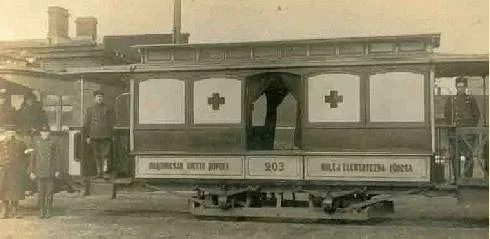
On 17 January 1901 a tram connecting Łódź with Pabianice began running - the first tram connection between two towns anywhere in what was then the Kingdom of Poland. Two days later a similar line towards Zgierz was launched. This was the beginning of a network that, over the following decades, grew into the largest suburban tram network in Poland.
How the network grew
After the first two lines, expansion proceeded gradually. In 1905 the route was extended to the Pabianice town hall, and in 1907 a concession was obtained for further sections - towards Aleksandrów Łódzki and Konstantynów Łódzki. In 1913 the concession rights were extended to further directions, though most of these ambitious plans were never realized. By 1924 trams were already reaching the railway station in Pabianice directly, which significantly eased transfers between rail and city transport for residents of the whole metropolitan area.
Plans that were never realized
The most ambitious projects envisioned tram connections to Zduńska Wola via Łask, to Brzeziny, Koluszki, and even to Piotrków Trybunalski. Of this last, longest route, only a fragment was ever built - the line reached Tuszyn, without extending further south. Had all the plans from 1907-1913 been fully realized, the Łódź suburban network would have been even more extensive - but even in its limited, actually built form, it remained a nationwide rarity for a long time.
How the network shrank
The network's greatest heyday fell in the first half of the 20th century, but its gradual dismantling had already begun by the 1990s. The line to Aleksandrów Łódzki was suspended in 1991, and a year later the connections to Zgierz and Lutomiersk were shut down. In February 2018 two further suburban lines were suspended - to Zgierz and to Ozorków. A year later, in 2019, the last connection to Lutomiersk was also suspended because of the poor technical condition of the track. The main reason for these decisions was the poor state of the tracks and overhead traction network, the repair of which required funding that could not be secured for years.
What remains today
Of the once extensive network, one connection has survived - the oldest one, to Pabianice, launched back in 1901. It is the only one still running uninterrupted today, making the Łódź - Pabianice route one of the longest continuously operating tram lines of its kind in Poland. In recent years a section of this route, between Pabianice and Ksawerów, has been modernized as part of the Łódzki Tramwaj Metropolitalny (Łódź Metropolitan Tram) project, showing that, despite earlier closures, the idea of a tram connecting Łódź with neighbouring towns still has its supporters.
Why this matters for the region's history
The history of this network is, at its core, the history of how Łódź and the surrounding textile towns functioned as a single economic organism long before anyone formally started talking about the Łódź metropolitan area. Workers commuted by tram between jobs in factories in Łódź, Pabianice and Zgierz, and for decades the network itself was one of the reasons these towns remained closely linked. Today, looking at the single surviving line to Pabianice, it is worth remembering that it was once just one of several arms of a much larger whole.
Where to see traces of that network
The history of Łódź's city and suburban transport, including old rolling stock and route documentation, can be explored in more depth at the Museum of Urban Transport in Łódź, open seasonally on a few days each month - it is worth checking the current schedule before visiting. More stories like this from the region can be found in the Poznaj Łódź section.
Be the first! Add a comment.
You need to log in to add a comment.
Log in