
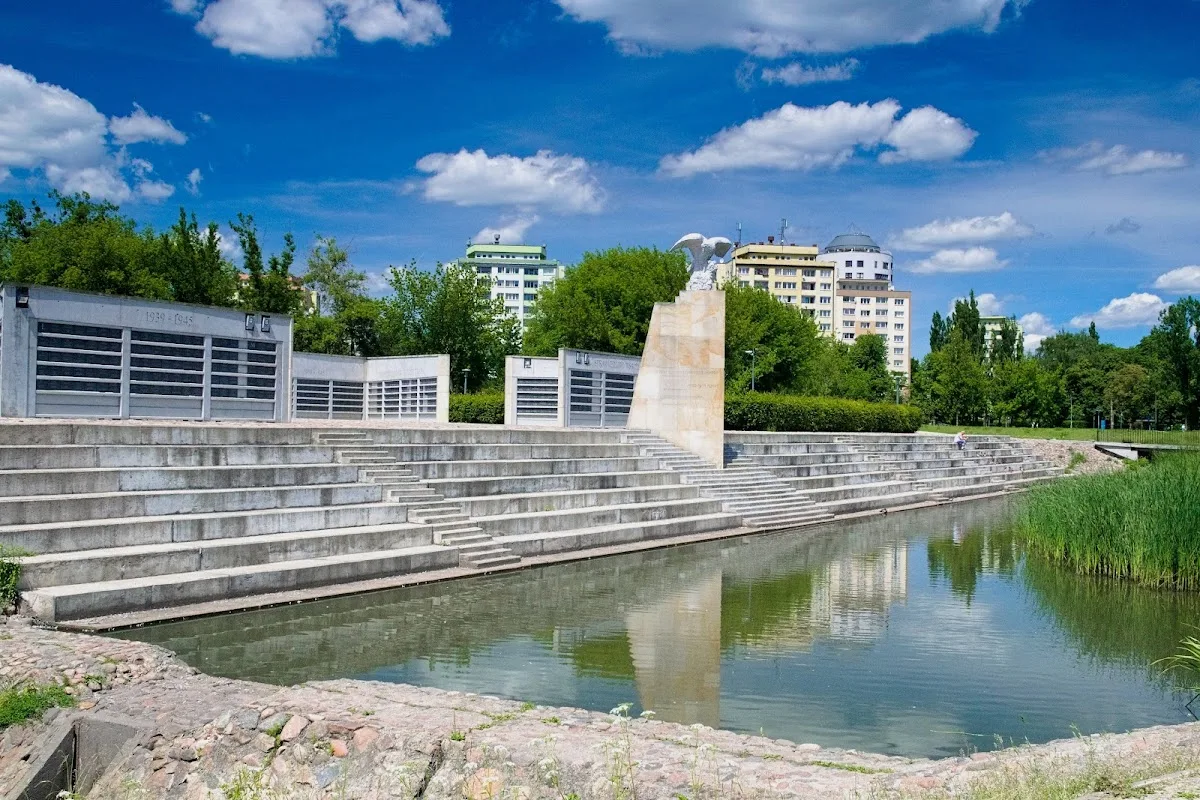
Park Ocalałych (Park of Survivors) was created in Łódź on 30 August 2004, exactly on the 60th anniversary of the liquidation of the Łódź Ghetto. It covers 8.5 hectares in the valley of the Łódka river, between Wojska Polskiego and Oblęgorska streets - one of the youngest parks in the city and also one of the few that were designed from the start to serve as a place of remembrance, not only recreation.
Where the name comes from
The park's name refers to the survivors of the Łódź Ghetto - a place where, during the occupation, more than 200,000 people were confined, of whom only a few thousand lived to see liberation. The park was created near the former ghetto grounds, as a place where mourning for the dead can coexist with the everyday life of a city that goes on.
The monument to the Righteous Among the Nations
The park's most important feature is a monument in the shape of the Star of David, unveiled in 2009. The star is formed from plaques bearing the names of around seven thousand Poles honoured by the Yad Vashem Institute with the title Righteous Among the Nations - people who, at the risk of their own lives, saved Jews from the Holocaust. Above the star is a White Eagle, the symbol of Poland, along with quotations from the Gospel and the Talmud in Polish, Hebrew and English, including the sentence "whoever saves one life, saves the entire world".
The Memory Mound and Jan Karski's bench
At the other end of the park rises the ten-metre Memory Mound (Kopiec Pamięci), which also serves as a viewpoint over the surrounding area. At its top stands a monument-bench dedicated to Jan Karski, a courier of the Polish Underground State, who in 1942 delivered an account of the Holocaust to the governments of the United Kingdom and the United States - one of the first direct eyewitness accounts passed on to the world, similarly important to the documents shown today at the Radegast Station.
The park as a place for a walk
Despite its serious commemorative function, Park Ocalałych today is above all an ordinary city park - with walking paths, benches and greenery used by local residents regardless of the season. This combination of recreational and commemorative functions means that for many visitors the park is their first contact with the history of Jewish Łódź - they discover it, in a way, in the course of an ordinary walk.
How to visit the park
The main entrances lead from Wojska Polskiego and Oblęgorska streets, both of which also have car parks. For those interested in the history, a multimedia route through the park is available, lasting around 55 minutes and covering descriptions of ten locations, including the Memory Mound and the Righteous monument - it is worth downloading it to your phone before the visit. A walk around the park's main points without the app takes around 30-40 minutes. Admission to the park is free, and the park is open to the public all year round.
What to see nearby
Park Ocalałych combines well with other places linked to the history of Jewish Łódź. In the city centre it is worth seeing the Reicher Synagogue, the only pre-war synagogue to have survived the occupation, and on Bracka street the New Jewish Cemetery with the Ghetto Field. Anyone wishing to see the place from which transports left for the death camps should visit Radegast Station.
More of the city's green spaces can be found among the parks and green areas of Łódź, and the wider historical context is gathered in the "Poznaj Łódź" (Discover Łódź) section.
Be the first! Add a comment.
You need to log in to add a comment.
Log in