
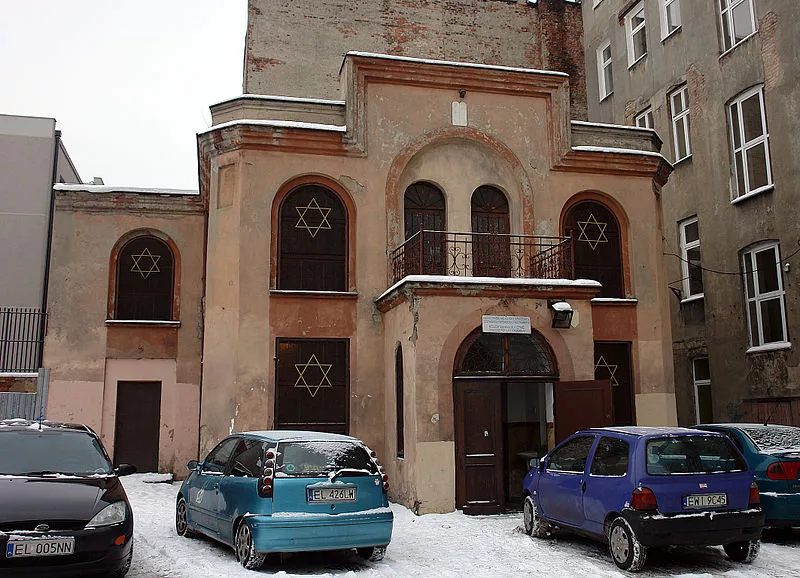
Of the more than 200,000 Jews living in Łódź before the war, fewer than ten percent survived the Holocaust. And yet, in the first postwar years, it was precisely Łódź, damaged by the occupation but physically preserved, that became the place to which Jewish survivors flocked from across Poland - a city that for a short time was the largest Jewish centre of the country reviving after the war.
Why Łódź of all places
Unlike Warsaw, destroyed to the extent of almost eighty percent, Łódź survived the war with relatively little damage to its urban fabric - flats, public buildings and infrastructure remained standing. This meant that in the first months after liberation the city became a natural destination for Jewish survivors, both those who had survived the occupation on Polish soil and repatriates returning from the Soviet Union.
Numbers that are still striking today
The rebuilding of the Jewish community of Łódź began as early as the second half of 1945, and its pace was surprisingly fast: at the start of 1946 nearly 30,000 Jews already lived in the city. By early July 1946 the Łódź Jewish committee had registered 56,758 people - as much as 23.3 percent of all registered Jews in the whole of postwar Poland. For a short time, then, Łódź was, on a national scale, the absolute centre of Jewish life - numerically more significant even than Warsaw.
Institutions established during this period
The rebuilding was not limited to the number of residents alone. As early as 1945 the Provisional Jewish Committee was formed, soon transformed into the Voivodeship Jewish Committee, which organised care for survivors returning to the city - a House for Repatriates was opened, along with orphanages and a student dormitory, and a number of social organisations and associations were established. The activity of the Reicher Synagogue, the only one to survive the war, was restored. In 1946 the Jewish Theatre was launched, the "Kinor" filmmakers' cooperative and a cooperative of visual artists were established, and more than 20 press titles were again being published in the city - in Yiddish, Hebrew and Polish.
A chapter that lasted only briefly
This period of intense rebuilding proved, however, to be transitory. Successive waves of emigration - after the Kielce pogrom in 1946, then in 1956-1957, and finally after the antisemitic campaign of March 1968 - steadily reduced the size of the Jewish community of Łódź, down to today's state of a few hundred registered community members. The chapter in which Łódź was the demographic centre of Jewish Poland lasted only a few postwar years, but during that short time the city played a role that few remember today.
Where to look for this history today
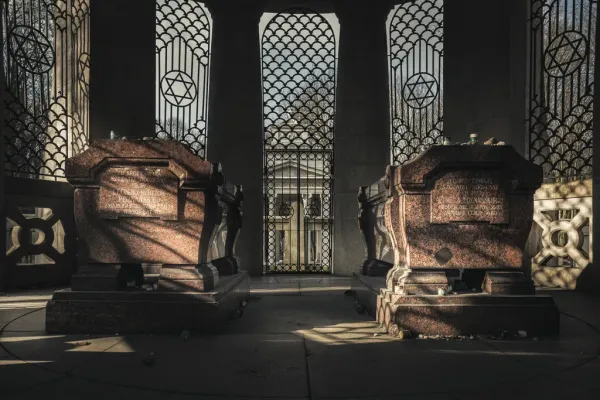
The traces of this brief, intense period of rebuilding are best explored by visiting the Jewish cemetery on Zagajnikowa street, where some people connected with the postwar rebuilding of the community are also buried, and by consulting the materials of the Marek Edelman Dialogue Centre, which documents the whole history of Jewish Łódź - from its pre-war splendour, through the Holocaust, to the brief postwar rebuilding and its gradual decline. More on the city's history in this period can be found in the Discover Łódź section.
Be the first! Add a comment.
You need to log in to add a comment.
Log in