
Tomaszów Mazowiecki lies less than an hour from Łódź and today is associated mainly with the Niebieskie Źródła (Blue Springs) and Groty Nagórzyckie (Nagórzyce Caves). Few people remember that a hundred years ago it was a town where one in three residents spoke Yiddish, and its history ended in a way that has to be understood to make sense of this region.
A town where one in three residents was Jewish
Tomaszów Mazowiecki was founded in the early 19th century on the initiative of Antoni Ostrowski, who brought craftsmen and merchants to his private town, counting on the growth of the textile industry. Among the first settlers were Jews - Jakub Steinman, owner of a cotton goods factory and a close associate of Ostrowski, and Jakub Kempner, leaseholder of the town's foundry and metal works. An independent Jewish community was established in 1831.
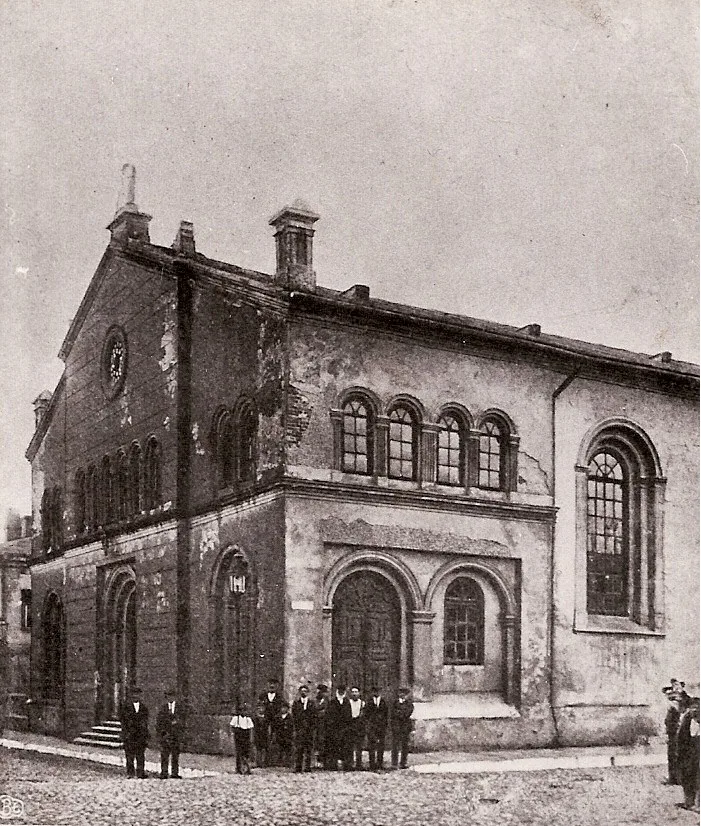
The town developed quickly thanks to weaving, cloth production and trade, and conditions for the Jewish community's growth were good - the town's owners directly encouraged people to settle and open workshops. In 1921 the Jewish population numbered over 10 thousand people, about 36 percent of the residents of Tomaszów Mazowiecki. On today's Berka Joselewicza street stood the Great Synagogue, one of the town's most important buildings.
September 1939 and the end of the pre-war world
The Great Synagogue in Tomaszów was demolished as early as 1939, in the first months of German occupation. It was one of the first signs that for the town's Jewish residents a completely different chapter of history was beginning than for the rest of Poland. The Germans quickly introduced economic restrictions and forced labour, and increasing numbers of refugees and displaced people from Łódź, Płock and Warsaw began arriving in the town.
A ghetto on three streets
The ghetto in Tomaszów Mazowiecki was established on 3 May 1940. About 16,500 people were gathered there - local Jews and arrivals from other towns. Initially the ghetto was not fenced, because it consisted of three separate parts scattered across different parts of the town, which at least in theory allowed contact with the rest of Tomaszów. Only in December 1941, when just one, consolidated district remained, was it fully isolated.
Conditions in the ghetto were very harsh. Kitchens run by the Judenrat handed out about 1,500 meals a day, which did not cover the needs of several thousand residents. There was a shortage of food, fuel and basic medical care, and new transports of people displaced from other towns in the Łódź region kept arriving in the ghetto.
Liquidation of the ghetto in the autumn of 1942
The liquidation of the ghetto in Tomaszów Mazowiecki lasted from 30 October to 1 November 1942. Most residents were deported to the Treblinka death camp, some were sent to labour camps. Of the several thousand people who passed through this ghetto, according to available sources only about 250 survived the war. That number speaks to the scale of the losses better than any description.
What still recalls Jewish Tomaszów today
Few traces of the pre-war community remain in the town - the Great Synagogue did not survive, and post-war development largely erased the former layout of the Jewish district. It is worth visiting the Muzeum im. Antoniego hr. Ostrowskiego (Count Antoni Ostrowski Museum), housed in the founder's palace, which holds a collection of Judaica - everyday and religious objects used by Tomaszów's Jewish residents. Today this is the most tangible way to see something of that lost world.
In practice: how to plan a visit
The museum keeps hours typical for this kind of institution - it is worth checking the current schedule before travelling, as it can be closed on public holidays. Visiting the historical exhibition together with the Judaica section takes at most an hour and a half. From Łódź, Tomaszów Mazowiecki can be reached by regional train in under an hour, which makes it a natural destination for a day trip.
If you are staying in town longer, the Rezerwat Przyrody Niebieskie Źródła (Blue Springs Nature Reserve) lies in the same area - it is worth combining the historical part of the visit with a short walk through the reserve, so the day in Tomaszów is not only about difficult history.
You can read more about the region and its multicultural past in materials from the Łódź Wielu Kultur (Łódź of Many Cultures) series and in the Poznaj Łódź (Discover Łódź) section, where you will find other articles about the region's Jewish history, including about Stacja Radegast (Radegast Station) and the Synagoga Reicherów (Reicher Family Synagogue) in Łódź.
Be the first! Add a comment.
You need to log in to add a comment.
Log in