
Zduńska Wola is one of those towns in the Łódź region whose history begins literally from nothing - from the decision of a single landowner who decided to bring in weavers and build an industrial settlement. Jewish residents were part of this story from the very beginning, and today the most tangible trace of their presence is the cemetery on Kacza street.
A town built from nothing by weavers
From 1817, Stefan Prawdzic-Złotnicki brought weavers from Silesia, Germany and Bohemia to his settlement, building a centre of the textile industry from the ground up. Thanks to this the town earned the nickname the Town of Weavers and was granted town rights in 1825. Jews were present in Zduńska Wola from the very start - the first mentions of Jewish residents date back to 1788, and an independent Jewish community (previously subordinate to Łask) was established in 1828.
Full religious infrastructure of the community
In 1902 the Jewish population numbered nearly 6,000 people, close to 30 percent of all the town's residents. The community had a full religious infrastructure: a large synagogue, a smaller synagogue, a house of prayer, ritual baths (mikvehs), a kosher poultry slaughterhouse, the Talmud Torah religious school and a pre-burial house. This shows the scale and self-sufficiency of this community - Zduńska Wola had everything the Jewish community needed to function independently of the rest of the town.
It is also worth mentioning that Saint Maximilian Kolbe was born in Zduńska Wola - the town therefore has a multi-layered, interesting religious history in which different traditions intertwine.
The cemetery on Kacza street
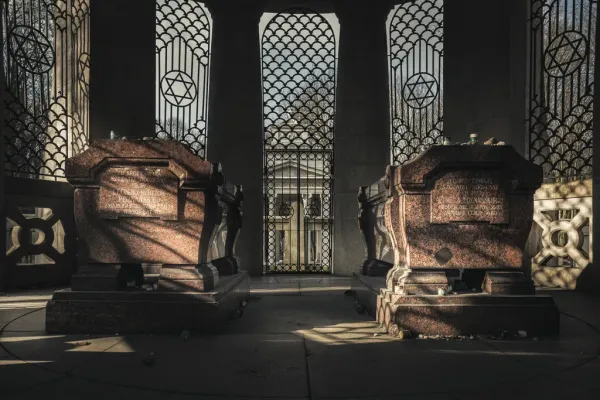
The Jewish cemetery was established in 1826, a year after the town was granted its town rights. It covers an area of about 2 hectares on today's Kacza street. The oldest legible gravestones date from 1832, and the last burial here took place in 1964. About 3,000 gravestones have survived - an exceptionally high number for a Polish Jewish necropolis, since in many other towns the matzevot were stolen during the war or used as building material.
The cemetery was seriously damaged by the Germans during the war, and after 1945 it deteriorated further through neglect. Today it is cared for by the Jachad Historical Society, an organisation of former residents of Zduńska Wola in Israel, the local authorities and the Museum of the History of the Town. Since 2010, an open day at the cemetery has been organised every August, during which it can be visited with a guide.
The synagogue of which only the site remains
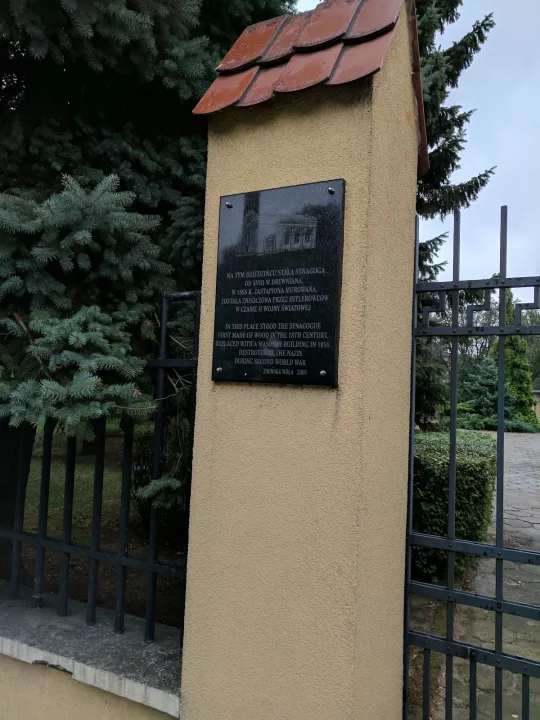
The large synagogue did not survive the war - today there is no longer a building on the site where it stood, and the only trace is a historical marker. This is a typical picture for the Łódź region: the cemetery, as a place by nature more durable and harder to destroy completely, survived far better than functional buildings, which could easily be demolished or rebuilt.
In practice: how to visit Jewish Zduńska Wola
The cemetery on Kacza street is still formally an active necropolis, so the same rules apply as at any Jewish cemetery: silence, respect, men traditionally cover their heads. Outside the open day in August, access can be limited - it is worth checking in advance with the site's caretaker whether it can be visited, rather than counting on the gate being open by chance.
You can learn more about the town's history and its multicultural past at the Museum of the History of the Town in the centre of Zduńska Wola, where you will also find information on the Jewish thread within the town's wider history.
From Łódź you can reach Zduńska Wola by regional train in about an hour. A wider context of the region's Jewish history can be found in the Łódź of Many Cultures series and in the Discover Łódź section, among others in the article on the Jewish cemetery in Łódź and on the Reicher Synagogue - the only synagogue in Łódź that survived the war, unlike the one in Zduńska Wola. More of the town's historic sites can be found on the collective page of Zduńska Wola's historic sites.
Be the first! Add a comment.
You need to log in to add a comment.
Log in