The Botanical Garden in Wieluń is a place where you can walk among a rich collection of plants and learn about botany. Ideal for a relaxing day in the open air, regardless of season.
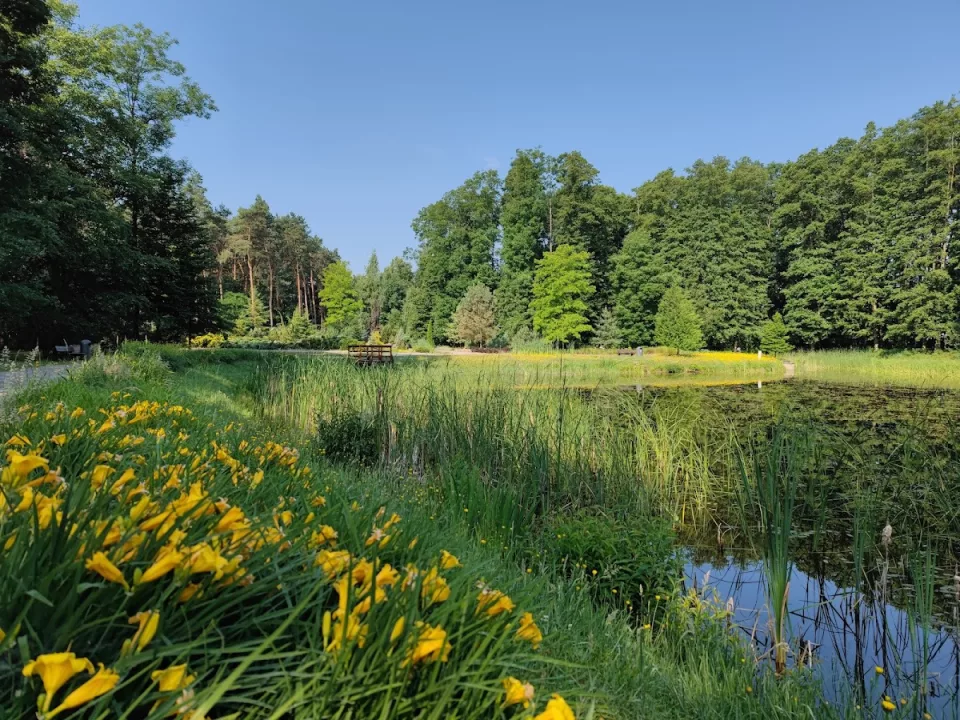
The Wieluń Botanical Garden comprises approximately ten hectares, fenced off between 1998 and 2000 from the larger Lasek Miejski (City Forest), on the north side of ulica Wojska Polskiego. The forest itself covers nearly thirty-eight hectares and borders a stadium, a former amphitheatre, allotment gardens and land belonging to the village of Turów. This is not a botanical garden in the style of university collections with a palm house, but rather an old stand of trees from inter-war plantings, given an educational and recreational function.
Before the forest was planted here, this was a place of executions and later a rubbish dump. The area bears the name Podszubienice, which appeared in 1844. During the January Uprising a gallows stood here and death sentences were carried out on insurgents, and in 1905, 1914 and 1915 patriotic demonstrations were held in this place. Until the 1920s the site served as a dump, only then was it cleared and afforested. The present-day tree stand comes from those plantings: larches, pines, spruces and oaks, and in the garden itself also birches and alders. The oldest specimens are therefore around a hundred years old. Pre-war Wieluń, before the wartime destruction, is shown in an exhibition at Muzeum Ziemi Wieluńskiej.
In the place of executions stands a monument with its own complicated history. A small sandstone obelisk was erected by the Wieluń municipal authority in 1925, with an inscription honouring the memory of the 1863 insurgents executed here, and a tablet with the names of six condemned men was placed beside it. In 1934, on 11 November, a new monument was unveiled from funds raised by the Federation of Polish Defenders of the Homeland and Wieluń starost Tadeusz Niżankowski, and during excavation work the remains of eight execution victims were found. The Germans destroyed it in 1940. Rebuilt according to a preserved model and financed by contributions from residents, the Monument to the Heroes of the January Uprising was unveiled again on 6 July 1958.
The main axis of the entire layout is a walking avenue running parallel to ulica Wojska Polskiego, until recently lined with seventy-year-old larches. Within the fenced area grow spruces, pines, birches, oaks and alders from plantings of the 1920s. Besides its recreational function the site was intended from the outset to serve educational purposes, for example field classes for pupils from Wieluń schools, for which purpose there is a didactic trail with boards and displays. The scope of what is actually marked and accessible today is best checked at the Wieluń town office before a longer visit with a group.
Along the Lasek Miejski runs the tourist trail Śladem Wieluńskiej Kolejki Wąskotorowej (In the Footsteps of the Wieluń Narrow-Gauge Railway), laid along the former railway bed. Within the Wieluń gmina (municipality) over four kilometres of the route has been surfaced, divided into two surfaces: a strip of aggregate two and a half metres wide for pedestrians, cyclists and riders, and a one and a half metre asphalt path for inline skaters. Along the trail two tourist service points have been created with tables, benches and toilets, as well as boards with the history and archival photographs of the railway.
| Monday | 00:00 – 24:00 |
| Tuesday ← today | 00:00 – 24:00 |
| Wednesday | 00:00 – 24:00 |
| Thursday | 00:00 – 24:00 |
| Friday | 00:00 – 24:00 |
| Saturday | 00:00 – 24:00 |
| Sunday | 00:00 – 24:00 |
Hours per Google Places - may change on public holidays.

Be the first! Add a comment.
You need to log in to add a comment.
Log in