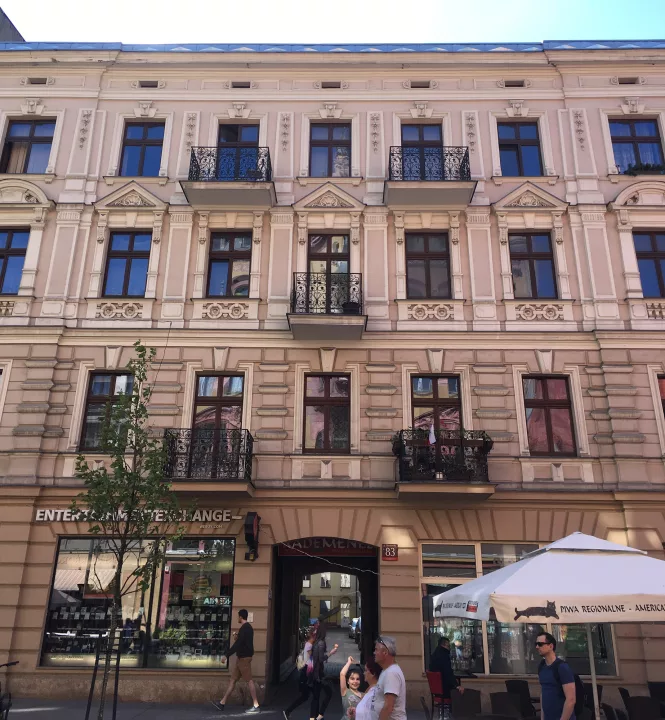
A listed tenement house on Piotrkowska Street that is a testament to Łódź's rich architectural history. Worth visiting for those interested in the city's history and pre-war aesthetics.
Chaim Jankiel Wiślicki Tenement House stands at Piotrkowska 83 and belongs to the oldest layer of buildings on this part of the street. The neo-Renaissance facade with five cast-iron balconies conceals a property where a fabric manufacturer ran a weaving mill, and in April 1943 young resistance fighters seized a German weapons store.
The property has a history older than the tenement house itself and reaches back to Łódź's early industrial years. In 1833, plot number 134 was taken over by weaver Karol Franke, brought from Saxony, obliged to run cotton and linen workshops and build a wooden house. In 1842, the property was purchased by blacksmith Samuel Meier.
Jankiel Chaim Wiślicki built the front tenement house in 1878: two storeys facing the street and three storeys facing the courtyard. In 1891, a three-storey hand weaving mill with an office building was erected on the property, and around 1894 the front was extended by another storey. Wiślicki himself began producing woollen fabrics and kerchiefs around 1868 in a putting-out system, and in the 1890s built a mechanised factory on Długa Street 126, today Gdańska Street. The family appeared as property owner in the house tariff of 1920.
The ground floor and outbuildings changed tenants for decades, and the list tells much about daily life on Piotrkowska. From 1890, Leon Lubotynowicz's technical office operated here, from 1905 a florist shop called "Julianów", from 1916 the "Świtezianka" restaurant run by Jan Pujdak, from 1918 Arnold Chasins's typewriter shop, and from 1930 the "Hakoah" sports club. There was also the "Violet" perfumery, a fashion salon, a workers' bookshop, dental surgeries and a technical supplies store. In the 1930s, coal company representatives had offices here. Rabbi Benjamin Mordechaj Segał, born in 1903, also lived here; he was deputy rabbi of the Jewish community who died in 1942 in the Łódź ghetto.
During the occupation, the building housed a German shop and weapons store, which was attacked by a youth resistance group. The action was carried out on 20 April 1943, on Hitler's birthday. The conspirators overpowered the staff and seized 10 pistols and 18,000 rounds of ammunition.
The "Promienisty" group was founded on 1 September 1941 and originated from the 16th Łódź Scout Troop in Bałuty. Its members were teenagers, including commander Stanisław Gajek with the pseudonym Leszek, as well as Franciszek Prożek, Eugeniusz Lisiak and Mieczysław Wołos. The organisation initially numbered around 40 people. After Gajek's arrest in July 1943, command was taken over by Henryka Fibak, who was murdered by the Germans. Eighteen group members died in combat or in gestapo torture chambers.
The tenement house is legally protected and entered in the register of immovable monuments under number A/34. It is part of an area designated as a Monument to History under the name "Łódź - multicultural landscape of an industrial city". The elevation is maintained in neo-Renaissance style, with rhythmic window division and two delicate side risalits that do not dominate the whole. The building has five storeys above ground and a basement, and a characteristic feature is five symmetrically arranged cast-iron balconies. In 2000-2001, renovation work was carried out: the facade was renewed, plaster restored and the courtyard elevations insulated.

Be the first! Add a comment.
You need to log in to add a comment.
Log in