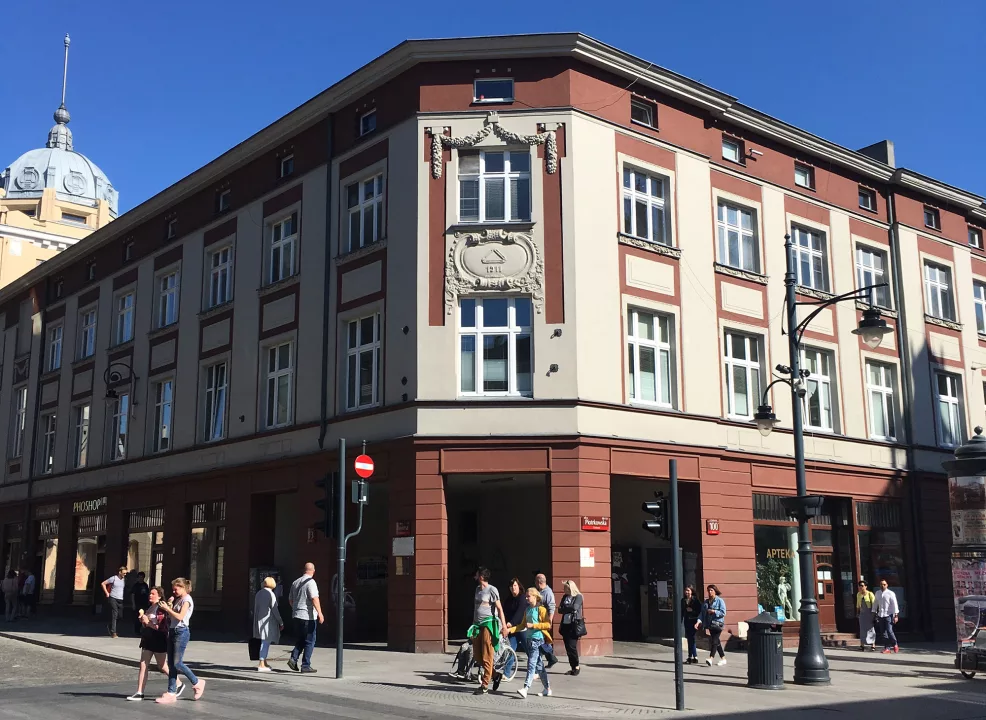
An Art Nouveau fashion house from 1909 on Piotrkowska street, known as Esplanada after the café opened there in 1926, a name still used today.
At Piotrkowska 100a stands one of Łódź's most renowned Art Nouveau buildings, known today as Esplanada. It was created as a fashion house for two merchants and for most of its history returned to catering functions, even after periods when it served a completely different purpose.
The building was erected in 1909 as a two-storey department store, or fashion house, for merchants Hugo Schmechel and Julian Rosner. It was designed by August Furuhjelm, an architect of Finnish origin who at the time served as city architect of Łódź. The fashion house stood on land leased from the Guild of Weaving Masters, the former Linen Weavers' Guild; its earlier headquarters, the so-called Meisterhaus, had stood on the site since 1839. Schmechel and Rosner put up the building at their own expense under an agreement signed in May 1909, and after ten years of leasing, in 1919, it passed into the guild's ownership. The fashion house's advertising slogan read: "the one who gives much gives something to everyone."
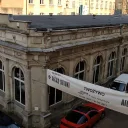
The building represents the Art Nouveau style and is considered one of the finest examples of this movement in Łódź, and indeed across the country. It is distinguished by an impressive shopfront on the ground floor, designed to display the merchandise shown in the fashion house windows.
On 31 December 1928 a new tenant, the confectioner Wawrzyniec Gierbich, transformed the premises into a café and patisserie, giving it the name Esplanada. Earlier that same year the premises had housed a café and patisserie run by a group of partners under the name Tivoli. It was the name Esplanada that became so strongly associated with the building that it is still used to this day, although the official registry entry lists it as the department store of Schmechel and Rosner.
During the German occupation the premises retained its catering function, operating under German administration. After 1946 the building came under the management of a consumers' cooperative and was converted into a department store, retaining only a small patisserie section. Only in the late 1990s was the building renovated and its original catering function restored, which it continues to serve today.




Be the first! Add a comment.
You need to log in to add a comment.
Log in