
Sieradz is one of the oldest towns in the Łódź region, mentioned in chronicles as early as the 12th century alongside Kraków and Gniezno. Just as long, though far less well known, is its Jewish history - reaching back to the Middle Ages and ending in a way typical of dozens of towns in the region: with destruction during the war.
A Jewish street six hundred years old
As early as the mid-15th century, Sieradz already had a Żydowska (Jewish) street - one of the oldest documented traces of Jewish presence in the region. An independent Jewish community in Sieradz, however, was only established in 1804 - before that, the local community formally belonged to the community in Łask. Among the families settled in Sieradz in the early 19th century, sources list the names Fajans, Białek, Kempiński and Rosenberg.
The synagogue that survived the war
On today's Wodna street, a brick synagogue was built between 1819 and 1824, probably to a design by the architect Hilary Szpilowski. Unlike many other Jewish houses of worship in the region, the building survived the war - the Germans gutted the interior and converted it into offices, and after the war the synagogue continued to be used as office space and craft workshops. Nothing survives of the original interior fittings (including the women's gallery and the elaborate neoclassical aron ha-kodesh setting), and the building itself is deteriorating today. A plaque commemorating the Jews of Sieradz has been placed on its wall.
The cemetery on Zakładników street
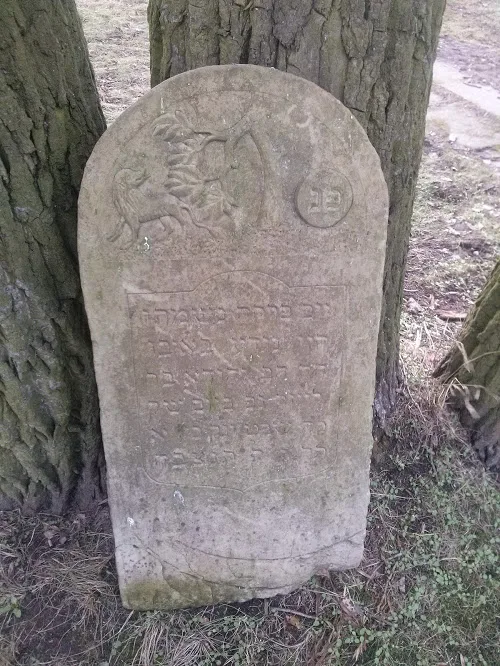
The Jewish cemetery in Sieradz was established in the early years of the 19th century - sources differ on the exact date, giving either 1804 or 1812. Whichever year is more accurate, it is one of the oldest surviving Jewish cemeteries in Poland, listed alongside the necropolises in Kraków and Warsaw. It covers an area of about 1.2 hectares on today's Zakładników street.
What survives of the cemetery is mainly fragments of broken gravestones - during the war the Germans devastated the site, using some of the gravestone slabs as building material. The name of Zakładników street, on which the cemetery lies, has its own tragic history: it was here that on 14 November 1939 the Germans shot twenty hostages from Sieradz, residents of the town taken as reprisal. After the war their remains were exhumed and laid to rest in a joint grave in the parish cemetery in Sieradz.
The ghetto and its liquidation
The ghetto in Sieradz was set up in the spring of 1940 in an area bounded by Wodna, Sukiennicza, Rybna and Zamkowa streets. About 3,000 people lived there, in conditions of extreme overcrowding - a single room often had to house between ten and fifteen people. The ghetto was liquidated on 24-27 August 1942: all residents were gathered in the local church and put through a selection, after which most were deported to the Chełmno nad Nerem extermination camp.
What recalls this history today
Besides the cemetery on Zakładników street, the best place to learn the wider context of the town's history is the Muzeum Okręgowe w Sieradzu (Sieradz Regional Museum), whose permanent exhibition also covers the region's centuries-long, multicultural history.
In practice: how to plan a visit
The cemetery on Zakładników street is still recognised as a burial site, so the same rules of conduct apply as at any Jewish cemetery: silence, respect for the place, men traditionally cover their heads. The grounds are sometimes closed, so it is worth checking whether it is accessible before visiting, rather than counting on being able to walk in by chance.
Sieradz lies further from Łódź than the other towns described in this series - the drive takes about an hour, and a bit longer by regional train. It is worth combining the visit with a full day in the town, taking in the Rynek w Sieradzu (Sieradz Market Square) and the nearby city parks along the Warta river as well.
More on the Jewish history of the Łódź region can be found in the Łódź Wielu Kultur (Łódź of Many Cultures) series and in the Poznaj Łódź (Discover Łódź) section, including in the article on the Jewish cemetery in Łódź.
Be the first! Add a comment.
You need to log in to add a comment.
Log in