
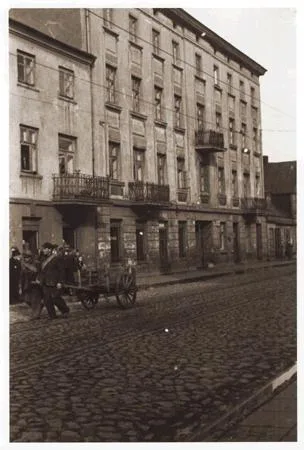
Among the historical sources on the Holocaust, there is one that stands out from all the others - the Chronicle of the Łódź ghetto. The Łódź ghetto is the only one in occupied Europe to have an almost complete, ongoing record of its own daily life, written by the ghetto's own residents on the order of its administration.
Who kept the chronicle, and why
The chronicle was kept on the order of Chaim Rumkowski, appointed Eldest of the Jews by the Germans, who set up a special Statistical Department in the ghetto. It was within this department that a team of chroniclers worked, mostly educated, pre-war journalists, teachers and officials, who recorded day after day what was happening in the ghetto: administrative events, black market prices, weather conditions, residents' moods, rumours, and, as the war went on, increasingly frequent mentions of hunger, disease and deportations.
What can be found in the chronicle
The chronicle's entries cover almost the entire period of the ghetto's existence, from its creation in 1940 to the last months before its liquidation in the summer of 1944. What makes this document exceptional is its thoroughness and consistency: the chroniclers recorded information that in other ghettos and camps was never written down or did not survive the war, prices of specific goods on the black market, air temperature, the number of deaths on a given day, along with small, everyday events that now allow historians to reconstruct what life in the ghetto really looked like, day by day, not only at major, decisive moments.
A five-volume scholarly edition
The chronicle's manuscripts survived the war and eventually made their way to the State Archive in Łódź, where, after years of research work, their full, five-volume scholarly edition was published in 2009. This publication is today the primary source for historians studying the everyday life of the Łódź ghetto - it allows the gradual tightening of living conditions, successive waves of deportations and residents' reactions to the changing situation to be traced, without having to rely solely on memoirs written down after the war, which are naturally shaped by the selectivity of memory.
Why historians value this source so highly
Unlike accounts written years later, the chronicle was compiled on an ongoing basis, in real time, which makes it a source free of the typical distortions of memory, errors in dates, confusion over the order of events, or unconscious simplification. At the same time, researchers point out that the very fact the chronicle was created on the order of the ghetto administration calls for cautious reading of certain passages, the chroniclers wrote under conditions of strict control, which may have influenced how some events were described, especially those directly connected with Rumkowski's decisions.
Where to learn more
The Chronicle of the Łódź ghetto is not an exhibit you can touch behind museum glass, it is above all an archival source, available today in the form of a scholarly book edition and, in part, in the digital collections of institutions studying the history of the Holocaust, including the Muzeum Miasta Łodzi (Museum of the City of Łódź). The context in which it was written is best understood by visiting Stacja Radegast, from where the transports later described in successive chronicle entries departed, and by learning about the history of the ghetto itself and the figure of Chaim Rumkowski, on whose order the chronicle was created.
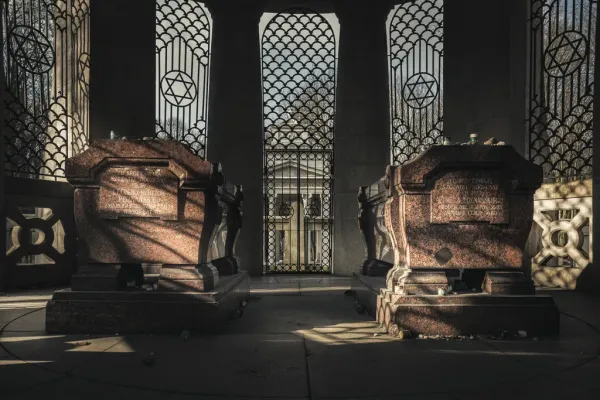
It is also worth visiting Park Ocalałych (Survivors' Park), dedicated to the memory of those who saved the lives of ghetto residents during the occupation, and the Jewish cemetery on ulica Zagajnikowa, where deceased ghetto residents were buried during its existence, as a complement to this difficult but important part of the city's history.
More material on the history of the Łódź ghetto and places of remembrance in Łódź can be found in the Poznaj Łódź (Discover Łódź) section.
Be the first! Add a comment.
You need to log in to add a comment.
Log in